How to Tell a Native Brook Trout From a Rainbow Trout
It's a common challenge for anglers exploring the beautiful, cool waters of South Carolina's Upstate mountains: trying to figure out if that shimmering fish you just caught is a native Brook Trout or a stocked Rainbow Trout. These two species, while both belonging to the trout family, have distinct characteristics that can be subtle to the untrained eye. Knowing the difference isn't just about satisfying curiosity; it's vital for adhering to regulations and playing your part in conserving our precious native fish populations. This guide will walk you through the key distinctions, helping you become a more informed and responsible angler.
Understanding South Carolina's Trout Landscape
Before we dive into the nitty-gritty of identification, let's set the stage for why these two species are found in the same waters, and why knowing the difference is so crucial. South Carolina's trout fishing is predominantly found in the Blue Ridge Mountains, where cold, clear streams provide the ideal environment.
A Tale of Two Trout: Native vs. Introduced
When you're out on a peaceful mountain stream in the Upstate, you're likely to encounter two primary trout species: the native Brook Trout and the introduced Rainbow Trout. Each has a unique history and role in our waterways.
The native Brook Trout, Salvelinus fontinalis, is an absolute gem. These fish are true natives of the Southern Appalachian region, having thrived in these cold, pristine headwater streams for thousands of years. They've adapted perfectly to the unique conditions of our mountain ecosystems, evolving alongside the land. For many anglers, catching a wild, native Brook Trout is a spiritual experience, a connection to the untouched wilderness of South Carolina. They are often considered an indicator species, meaning their presence signifies a healthy, undisturbed stream environment. Protecting these fish and their habitats is a cornerstone of responsible angling in the state. You can learn more about their unique heritage in South Carolina's Native Brook Trout: A Blue Ridge Mountain Original.
On the other hand, the Rainbow Trout, Oncorhynchus mykiss, is a more recent addition to South Carolina's waters, introduced from the western United States. These fish are widely stocked by the South Carolina Department of Natural Resources (SCDNR) to enhance recreational fishing opportunities. Rainbows are incredibly popular with anglers due to their spirited fight and willingness to bite. They're adaptable and can tolerate a broader range of water conditions than their native brook cousins, making them excellent candidates for stocking programs in various streams and rivers. While not native, they provide fantastic fishing experiences for countless people, making them a vital part of the state's angling culture.
Why Identification Matters for Anglers
You might be thinking, "A trout is a trout, right?" Not quite, especially when it comes to South Carolina's diverse angling opportunities. Accurate identification between a native Brook Trout and a Rainbow Trout holds significant weight, both for conservation and for staying on the right side of the law.
For conservation, distinguishing between the two is paramount. Native Brook Trout populations are often fragile, susceptible to habitat degradation, pollution, and competition from introduced species. Many of the smaller, higher-elevation streams where you find native "brookies" are managed with stricter regulations, sometimes even mandating catch-and-release only. Misidentifying a native Brook Trout as a more abundant Rainbow Trout and keeping it could inadvertently harm a delicate population. We want to preserve these beautiful wild fish for generations to come, and that starts with knowing what we're looking at.
From a regulatory standpoint, the stakes can be even higher. The SCDNR has different rules for different species, and sometimes even for different streams or sections of streams, specifically to protect native populations. Bag limits, size restrictions, and even permitted tackle types can vary. For example, some designated "Heritage Trout Waters" might have special rules aimed at protecting native Brook Trout. Unknowingly exceeding a limit or keeping a fish from a catch-and-release stream because of misidentification can lead to fines and penalties. Always consult the latest South Carolina's Freshwater Fishing Regulations before heading out to ensure you're fishing responsibly and legally.
Key Visual Differences: A Side-by-Side Look
When you've got a fish in hand, there are several key visual characteristics that will help you confidently tell if you're holding a native Brook Trout or a Rainbow Trout. These aren't always immediately obvious, but with a little practice and attention to detail, they become clear.
Coloration and Markings: The Tell-Tale Signs
The first thing most people notice about a trout is its color, and this is often where the biggest clues lie.
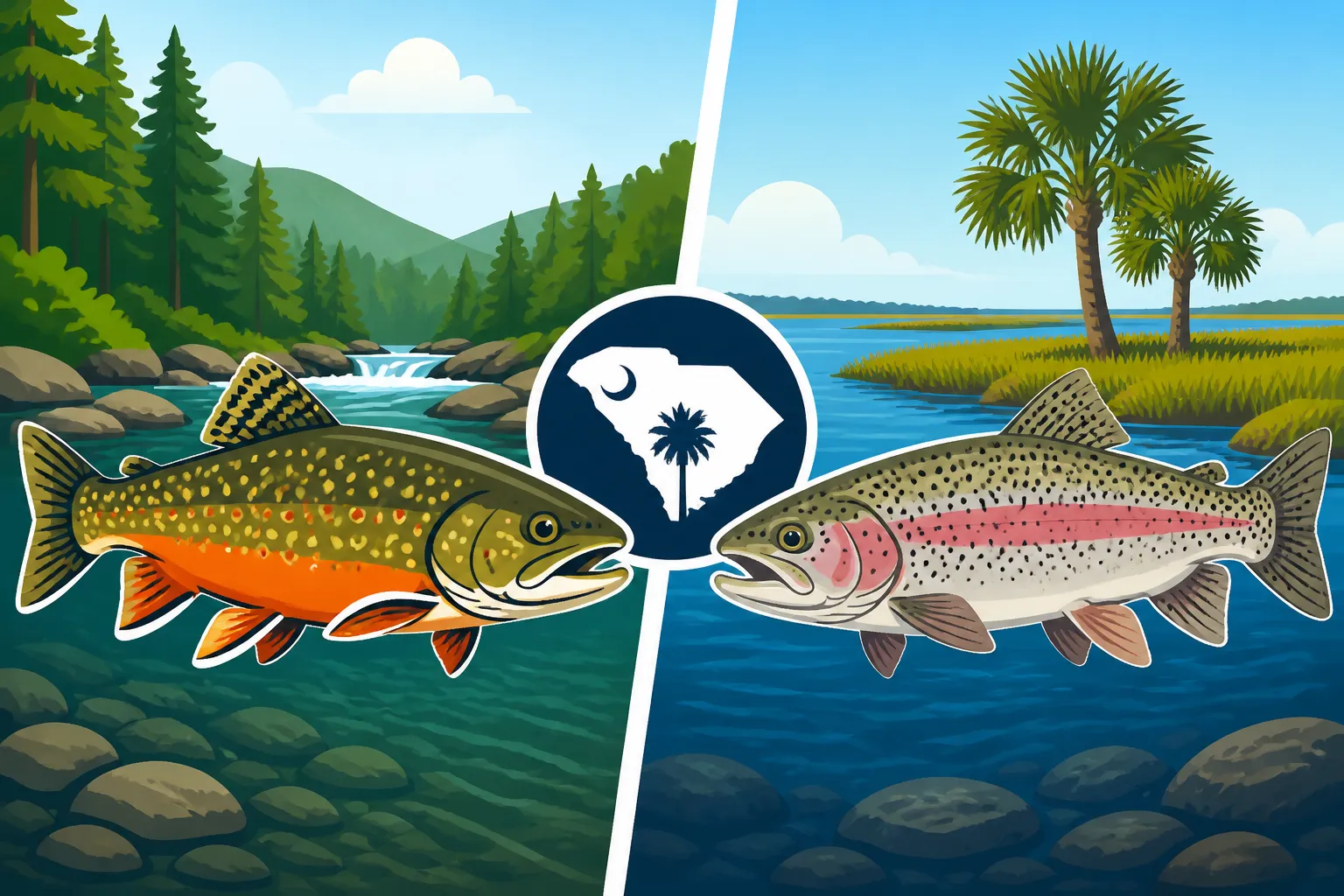
Let's start with the Native Brook Trout. These fish boast some of the most stunning and unique colorations you'll find in freshwater. Their backs are typically a dark, rich green or brown, often with distinctive, irregular, worm-like markings that extend onto the dorsal fin. These markings, called "vermiculations," are a definitive identifier and are absent on a Rainbow Trout. Their sides are usually adorned with scattered, light-colored spots, which can be cream, yellow, or even red, often surrounded by faint blue halos. These spots are not black. Perhaps the most unmistakable feature, however, is on their lower fins (pectoral, pelvic, and anal fins). They will have brilliant white leading edges, immediately followed by a narrow black stripe. This "white-black-red" fin pattern is a dead giveaway for a brook trout. You won't see a prominent horizontal red stripe along their lateral line; instead, their overall body color is more mottled and earthy.
Now, consider the Rainbow Trout. As their name suggests, they can sometimes display a beautiful, iridescent sheen, especially when fresh from the water or during spawning season. Their most famous characteristic is usually a vibrant, often prominent, red or pink horizontal stripe that runs along their lateral line, from gill plate to tail. This "rainbow" stripe can range from subtle to intensely bright. Their body color typically ranges from a silvery-steel blue to a brassy green on the back, fading to white on the belly. Unlike brook trout, Rainbows are covered in numerous, small, distinct black spots. These spots are usually peppered across their back, sides, and notably, onto their tail fin. You won't see the worm-like vermiculations or the distinct white-black fin edges that define the brook trout.
Body Shape and Fin Characteristics
Beyond color, the overall body shape and specific fin characteristics can offer additional confirmation for identification.
Brook Trout tend to have a slightly more robust, chunky body compared to the more streamlined Rainbow. Their profile is often described as a bit more "cigar-shaped" or compact, especially in the smaller specimens found in native streams. Their tail fin (caudal fin) is typically square or only very slightly emarginate (meaning it has a very shallow fork). The mouth of a brook trout generally appears smaller in proportion to its head than that of a rainbow trout. When you hold one, it often feels solid and thick for its length.
Rainbow Trout, especially those that spend time in larger waters or wilder populations, tend to have a more streamlined, torpedo-like body, built for speed and fighting current. Their tail fin is usually noticeably forked, sometimes quite deeply, which contrasts sharply with the brook trout's square tail. They also often have a somewhat larger mouth, extending back towards or even past the eye. These subtle differences in body and fin shape, when combined with their distinct coloration, provide a clear picture of which species you've encountered.
Habitat, Behavior, and Size Discrepancies
Beyond just looks, where you find a trout, how big it is, and even how it behaves can offer clues to its identity. These ecological and biological factors often reinforce the visual distinctions.
Where They Live: Different Preferences
Think of trout as having distinct neighborhood preferences. Knowing the typical haunts of each species can often tell you what you're likely to encounter before you even make a cast.
Native Brook Trout are real homebodies when it comes to their environment. They absolutely demand the coldest, cleanest, and most highly oxygenated headwater streams. You'll typically find them at higher elevations in the Blue Ridge Mountains, in streams fed by pristine springs or snowmelt. These are often the smaller, secluded creeks, sometimes barely more than a trickle, tucked deep within undeveloped forests. Brook trout are notoriously sensitive to changes in water temperature, pollution, and siltation. They really thrive in undisturbed environments, seeking out deep pockets, undercut banks, and complex woody debris for cover and ambush points. If you're hiking into a truly wild, remote mountain stream in South Carolina, especially one known for its delicate ecosystem, you're almost certainly in Native Brook Trout Streams in South Carolina's Blue Ridge Mountains territory.
Rainbow Trout, while still preferring cool water, are far more adaptable. They can tolerate slightly warmer temperatures and more disturbed habitats than brook trout. This is why you'll find them in a wider range of waterways, including larger rivers, tailwaters below dams, and lower-elevation streams, particularly those that are regularly stocked. While they can certainly thrive in wild, pristine conditions, their resilience makes them suitable for heavily fished areas. They are often stocked in rivers and streams that can handle higher fishing pressure. If you're fishing a popular, easily accessible stream or a larger river that receives regular hatchery introductions, you're likely targeting Rainbow Trout, though you might occasionally find a Brook Trout that has drifted downstream from its native habitat.
Typical Size and Growth Patterns
Size isn't always a perfect indicator, as fish growth depends on food availability and genetics, but generally, there's a noticeable difference between the two species in South Carolina.
In their native headwater streams, Brook Trout in South Carolina tend to be on the smaller side. A 6 to 10-inch "brookie" is considered a respectable catch, and anything over 12 inches is often a trophy. They have slower growth rates due to the colder, less nutrient-rich environments they inhabit. These fish prioritize survival in challenging conditions over rapid growth. Catching a truly large, old native Brook Trout is a rare and special event, a testament to its longevity in a harsh environment.
Rainbow Trout, especially those that come from hatchery programs or live in richer, larger waters, can grow much larger and at a faster rate. It's not uncommon to catch Rainbow Trout in the 12-18 inch range, and larger specimens are certainly possible, especially in waters with abundant food sources or consistent stocking. The goal of many stocking programs is to provide a good-sized fish for anglers to catch, so hatchery-raised rainbows often reach a "pan-sized" length relatively quickly. Keep in mind, however, that wild-spawned rainbows in optimal conditions can also grow quite large, showcasing their impressive genetic potential. Always check South Carolina Stocked Trout Daily Limit for specific regulations on what sizes you can keep.
Behavior and Feeding Habits
Observing how a trout behaves and what it's willing to eat can sometimes offer a final piece to the identification puzzle.
Brook Trout are often described as more elusive and cautious. They prefer to hold in tight cover: undercuts, around fallen logs, beneath boulders, or in deep, dark pools. They are ambush predators, often darting out from cover to grab a passing meal. Their diet primarily consists of aquatic insects (nymphs, larvae), small terrestrial insects that fall into the water, and sometimes very small minnows. They might be a bit pickier with their takes, requiring more subtle presentations.
Rainbow Trout, especially those accustomed to hatchery feeding or popular fishing pressure, can be more aggressive and less wary. They are often found actively feeding in open runs, riffles, and seams where current brings food to them. They're typically eager to strike a variety of offerings, from natural baits like worms and corn to artificial lures like spinners and flies. Their diet is broad, including insects, crustaceans, and smaller fish. You might find them more willing to chase down a lure or take a bait presented in more open water. Of course, wild rainbows can be just as cautious as brook trout, but generally, stocked fish are less finicky. Fly Fishing Techniques for Stocked Trout and Spin Fishing Techniques for Stocked Trout often highlight methods for these more active feeders.
Here's a handy table to summarize the key differences:
| Feature | Native Brook Trout (Salvelinus fontinalis) | Rainbow Trout (Oncorhynchus mykiss) |
|---|---|---|
| Coloration | Dark green/brown back, marbled "vermiculations" (worm-like patterns), light spots (often red with blue halos). No distinct horizontal stripe. | Silvery, steel-blue, or brassy sides. Prominent pink/red horizontal stripe (especially during spawning). Many small black spots. |
| Spots | Small, light (cream, yellow, red) spots, often with blue halos, no spots on tail. | Numerous small, distinct black spots all over body and tail fin. |
| Fins | Lower fins (pectoral, pelvic, anal) have distinct white leading edge with a black stripe. | No white leading edges on fins. |
| Tail Fin | Square or slightly emarginate (not deeply forked). | Moderately to deeply forked, especially in wilder strains. |
| Body Shape | Robust, chunky, often more compact. | Sleeker, more streamlined, built for speed. |
| Habitat | Cold, clear, highly oxygenated headwater streams, higher elevations. Very sensitive to warm water/pollution. | Wider range of habitats, including slightly warmer water. Commonly stocked in larger streams and rivers. |
| Average Size | Generally smaller (6-10 inches in native streams), slower growth. | Can grow much larger, especially in stocked or richer waters (often 8-15+ inches), faster growth. |
What to Do After Identification: Respecting the Resource
Once you've confidently identified your catch, the next step is acting responsibly. This is where your knowledge truly makes a difference, ensuring sustainable fishing for everyone.
Catch and Release for Native Brooks
If you've caught a beautiful native Brook Trout, the best practice, and often a regulatory requirement in many Best Streams for Brook Trout in the Blue Ridge Mountains, is to practice careful catch and release. These fish are a precious, irreplaceable part of South Carolina's natural heritage. Their populations can be fragile, and every fish released safely increases the chances for future generations.
When practicing catch and release, handle the fish as little as possible. Keep it in the water if you can, especially if you just want a quick photo. Use wet hands to minimize damage to its protective slime coat. Remove the hook gently and quickly, using forceps or needle-nose pliers, which you can easily find on Amazon. If the fish is deeply hooked, it's sometimes better to cut the line close to the hook than to try and dig it out, which can cause more damage. Use a rubberized net rather than a knotted nylon net, as the rubber is much gentler on the fish's fins and slime. Hold the fish upright in the current, allowing water to flow over its gills, until it swims away under its own power. Your actions directly contribute to the health and abundance of these remarkable fish.
Understanding Regulations for Both Species
No matter what you've caught, understanding and adhering to the current fishing regulations is non-negotiable. As mentioned, rules can vary significantly between species, and even between different bodies of water. For instance, How Trout Limits Vary by Stream in South Carolina and Checking a Stream's Trout Limit Before You Fish It are critical resources.
Always take the time to consult the latest South Carolina Department of Natural Resources (SCDNR) fishing regulations, either online or by picking up a physical copy wherever licenses are sold. This is your definitive guide to bag limits, size restrictions, and any special stream-specific rules. Some streams might have "single hook artificial lure only" rules, or a specific slot limit for certain species. Ignoring these regulations, even accidentally, can lead to unpleasant consequences. If you hold a South Carolina Fishing License Guide, you'll find the regulations information readily available. Responsible anglers are always informed anglers.
Essential Gear for Responsible Angling
Having the right gear doesn't just make your fishing trip more enjoyable; it also helps you be a more responsible steward of our natural resources.
For instance, using barbless hooks or crimping down the barbs on your hooks is a simple modification that makes hook removal much easier and less traumatic for the fish, especially if you're practicing catch and release. You can buy barbless hooks directly or modify your existing ones with a pair of pliers. Having a pair of long-nosed pliers or forceps (which you can easily find on Amazon) is indispensable for quickly and safely removing hooks, minimizing handling time.
A good quality landing net with a rubberized or knotless mesh is also a fantastic investment. Unlike traditional knotted nylon nets, rubber nets are much gentler on a fish's delicate fins and scales, and they don't strip away the essential slime coat that protects the fish from disease. This is particularly important for Brook Trout. You can find excellent options for rubberized nets online on platforms like Amazon. Preparing your gear with responsible angling in mind ensures that you're ready to do your part in preserving South Carolina's incredible trout fishing for years to come.
Disclaimer
This article is for general informational purposes only and does not constitute professional advice. Laws, prices and regulations vary by location and change over time. Consult a qualified professional for guidance on your specific situation.