Hybrid Striped Bass vs Striped Bass: What’s the Difference
It's a classic South Carolina fishing conundrum, isn't it? You're out on the lake, the rod bends over, and after a fantastic fight, you pull in a fish that looks like a striper, but something feels a little off. Is it a purebred Striped Bass, or one of those hard-fighting Hybrids? The confusion is real, and it can make a big difference, not just for bragging rights, but for understanding regulations. This comprehensive guide is here to unravel that mystery, helping you confidently identify the differences between these two beloved fish species that call our Palmetto State waters home.
The Purebred Powerhouse: Understanding the Striped Bass
When we talk about Striped Bass, or "stripers" as many of us lovingly call them, we're talking about a fish that embodies power and grace. These are the true, native wonders of our waters, known for their incredible runs and impressive size. Catching a purebred striper is a badge of honor for any angler. You can learn more about this iconic species in Striped Bass: South Carolina's Official State Fish.
Distinguishing Features of True Stripers
A purebred Striped Bass is a magnificent creature, often identifiable by its sleek, torpedo-like body built for speed and long migrations. When you look closely, you'll notice their head is quite large in proportion to their body, with a prominent lower jaw that extends slightly beyond the upper jaw. Their scales have a silvery sheen, often with a darker, bluish-green back fading into a white belly.
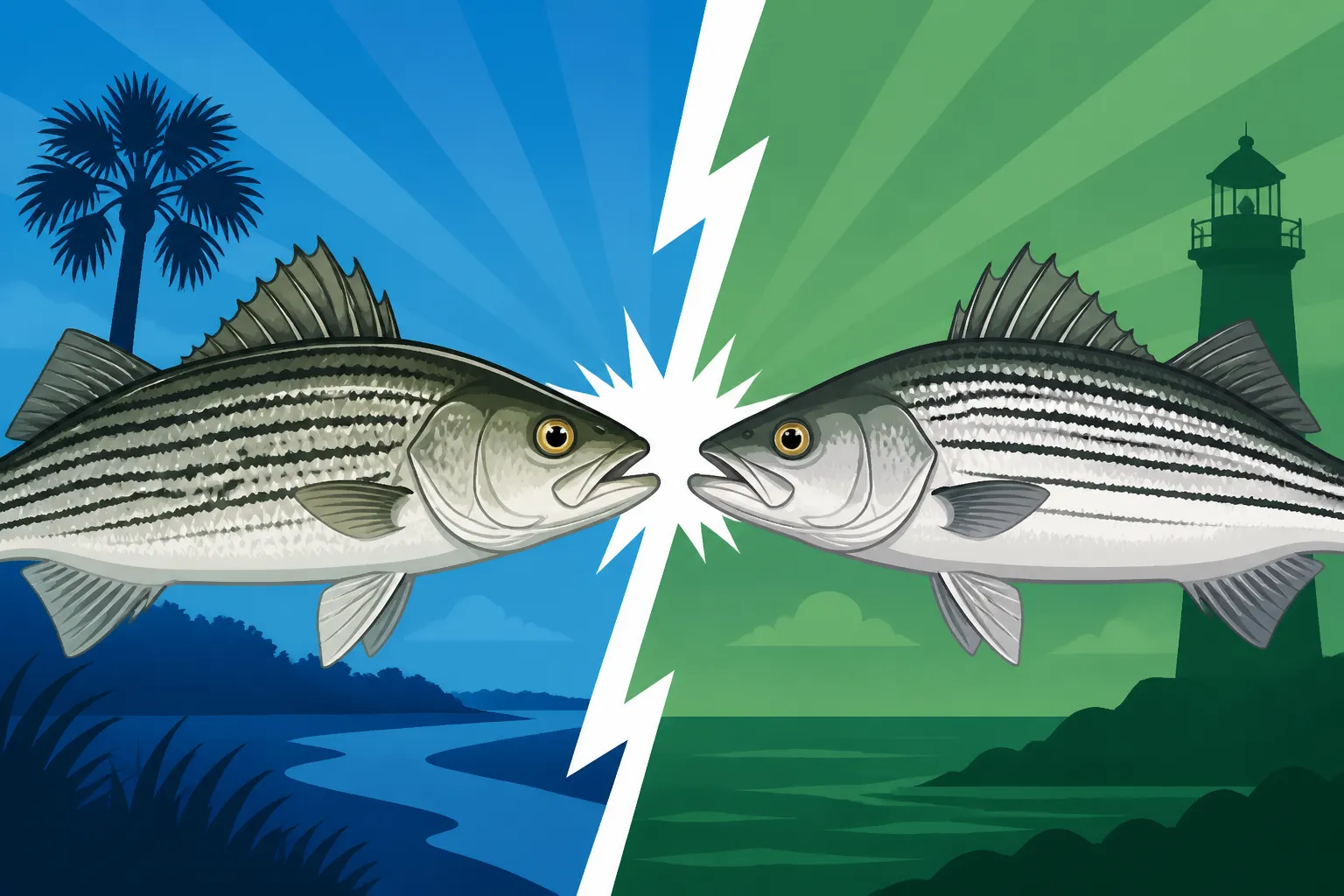
But the real tell-tale sign, the one we often look for first, are their lateral lines. Striped Bass typically have seven or eight distinct, dark stripes running horizontally along their sides. The critical part? These stripes are usually solid and unbroken from gill plate to tail. There might be a slight curve or a faint line, but for the most part, they are continuous, like perfectly painted lines on a race car. They appear incredibly streamlined, designed to cut through water with minimal resistance.
Natural Habitat and Behavior in South Carolina
In South Carolina, Striped Bass exhibit fascinating life cycles. We have populations that are truly anadromous, meaning they migrate from saltwater estuaries up into freshwater rivers to spawn, much like their ancestors. Rivers like the Santee, Cooper, and Edisto see these majestic fish making their seasonal runs, a testament to their wild heritage. It’s an amazing spectacle to witness, though these migratory populations are often more elusive for the average angler. You can delve deeper into their movements by reading Striped Bass Migration Up South Carolina's Coastal Rivers.
Beyond the coastal rivers, South Carolina is famous for its landlocked populations of Striped Bass, thriving in vast freshwater reservoirs. Lakes like Murray, Wateree, and the massive Santee Cooper system (Lake Marion and Lake Moultrie) are prime examples. Here, these stripers have adapted to a completely freshwater existence, feasting on abundant baitfish like threadfin and gizzard shad. They prefer cooler, oxygen-rich waters and will often school tightly, especially when ambushing bait. Their schooling behavior is a key trait, and finding one often means finding many, leading to exhilarating fishing frenzies.
The Angler's Favorite Blend: Decoding the Hybrid Striped Bass
Now, let's talk about the Hybrid Striped Bass. These fish are a marvel of fisheries management, offering a fantastic sportfishing opportunity that's often more accessible and equally thrilling. Sometimes called "wipers" or "sunshine bass" depending on where you are, they are a crossbreed with distinct characteristics.
Key Physical Traits of Hybrids
A Hybrid Striped Bass is exactly what it sounds like: a cross between a Striped Bass and a White Bass. This genetic blend gives them some unique physical attributes. While they share the general elongated body shape of a striper, hybrids tend to be a bit more stout or "football-shaped" – they carry more girth for their length, giving them a more compact, muscular appearance.
The most reliable visual cue, however, lies in those lateral stripes. Unlike the purebred's solid lines, the Hybrid Striped Bass will almost always have stripes that are noticeably broken, interrupted, or even splotchy. You'll see several of the dark lines stopping and starting, or zig-zagging in a non-continuous pattern. It's like someone drew the stripes, then smudged or skipped sections. They usually have fewer distinct stripes than a purebred striper, typically around five to seven, with several of them being quite disjointed. This is the single best field identification trick. For more on where to find these feisty fish, check out Hybrid Striped Bass Fishing Spots in South Carolina.
Preferred Environment and Feeding Habits
Hybrid Striped Bass are predominantly found in the larger freshwater lakes and reservoirs across South Carolina, places like Lake Murray, Lake Wateree, and the Santee Cooper lakes. They are largely a product of state fisheries programs, where they are stocked to create a robust and aggressive sport fishery. Because they're a hybrid, they often tolerate a wider range of water conditions than purebred stripers, making them incredibly adaptable and resilient in reservoir environments.
Their feeding habits are nothing short of aggressive. Hybrids are opportunistic predators, often schooling in open water and relentlessly pursuing baitfish. They are known for their powerful strikes and sustained fights, making them a favorite target for many anglers. They tend to be very active feeders, especially during dawn and dusk, or when large schools of baitfish are present. Because they grow quickly and fight so hard, they are a fantastic species to target, providing consistent action for anglers of all skill levels.
Practical Identification: Spotting the Differences on the Water
Let's get down to the nitty-gritty of identifying these fish when you're actually holding one. This can be tricky, especially if you're excited after a strong battle, but with a few key observations, you'll become a pro at telling them apart.
Counting Lateral Lines and Stripes
This is hands down the most reliable visual indicator. Imagine you've just reeled in a nice fish on Lake Marion, and you're trying to figure out if it's a striper or a hybrid. Gently hold the fish and carefully examine the dark horizontal stripes along its side.
For a purebred Striped Bass, you should see those beautiful, uninterrupted lines. They run straight and true, all the way from the gills to the base of the tail. They often have a very clean, uniform look. If you run your finger along a stripe, it should feel continuous, even if it's faint in places.
Now, if it's a Hybrid Striped Bass, you'll immediately notice the difference. Look for those broken or fragmented lines. Some lines might be perfectly solid, especially the one running along the lateral line (the sensory line running down the side of the fish). But many of the other stripes, particularly those below the lateral line, will be clearly discontinuous. They might stop and restart, or appear as a series of dashes rather than a solid line. It’s like a puzzle where pieces are missing or misaligned.
Body Shape and Fin Characteristics
While the stripes are primary, body shape also offers a good secondary clue. A purebred Striped Bass will generally have a more elongated, slender, and hydrodynamic profile. Think of a sleek submarine. They can grow quite long, and even when large, they retain that graceful, stretched appearance.
The Hybrid Striped Bass, on the other hand, tends to be deeper-bodied and more compact for its length. They often appear thicker or more "chunky" than a purebred of similar length. It's that "football" shape we mentioned earlier. This stockier build contributes to their powerful, short bursts of fight. Another, more subtle, characteristic sometimes involves the fins. White Bass (one of the hybrid's parents) have a dorsal fin and anal fin that are roughly equal in height. Hybrids often show this influence, having an anal fin that is relatively longer or taller compared to a purebred striper, though this can be harder to judge quickly on the water.
Here's a quick comparison table to help you out:
| Feature | Purebred Striped Bass | Hybrid Striped Bass |
|---|---|---|
| Body Shape | Sleek, elongated, torpedo-shaped | Stockier, deeper-bodied, more "football-shaped" |
| Lateral Stripes | 7-8 dark, solid, unbroken lines | 5-7 dark lines, with many broken or interrupted |
| Head/Jaw | Larger head, lower jaw protrudes slightly | Head size more proportionate, jaws often even |
| Overall Size | Can grow much larger (often 20+ lbs) | Typically smaller (often 5-15 lbs), though can exceed this |
| Parentage | Pure Morone saxatilis | Cross between Striped Bass and White Bass |
Why Identification Matters: Regulations and Fishing Strategies
Knowing whether you've landed a purebred or a hybrid isn't just for showing off your fish ID skills; it's genuinely important for complying with South Carolina's fishing laws and for optimizing your angling success.
Understanding South Carolina's Fishing Regulations
This is where identifying your catch correctly becomes critical. South Carolina, like many states, often has different regulations—specifically, different size limits and creel limits (the number of fish you can keep)—for Striped Bass and Hybrid Striped Bass, and these regulations can even vary by lake or river system. For instance, the regulations on Lake Murray might be distinct from those on the Santee Cooper lakes, or different for coastal migratory stripers versus landlocked populations.
Imagine you're fishing on a lake that has a 15-inch minimum for hybrids but an 18-inch minimum for purebred stripers. If you mistakenly identify a 16-inch purebred as a hybrid, you could be in violation. Enforcement officers are well-versed in these distinctions, and ignorance of the law is rarely an excuse. It's always a good idea to consult the latest South Carolina Department of Natural Resources (SCDNR) regulations before heading out, especially for specific bodies of water. Understanding these rules is part of being a responsible angler, and you can find general guidance in South Carolina Fishing Bag Limits Explained. Always double-check the most current regulations for the specific body of water you're fishing.
Tailoring Your Fishing Approach
Your identification skills can also influence your fishing strategy. While both species are aggressive predators, subtle differences in their behavior and preferred forage can mean the difference between a slow day and a banner day. For example, purebred Striped Bass in coastal rivers might be more receptive to certain types of live bait during their spawning runs, or react differently to current conditions.
Hybrids, being very aggressive and often stocked in high densities, might be more prone to hitting a wider variety of artificial lures with high-speed retrieves. If you're targeting big, trophy-sized purebred stripers in the deep, landlocked reservoirs, your tackle and depth presentation will likely be different than if you're trying to fill a cooler with hard-fighting hybrids. Understanding which species you're primarily encountering helps you select the right lures, baits, and techniques for maximum success. Best Lures for Striped Bass in South Carolina offers some great insights into what gets bites. Many experienced fishing guides in South Carolina specialize in one or both species, and their knowledge of identification and behavior is invaluable. If you're looking for expert help, Choosing the Right South Carolina Fishing Guide can point you in the right direction.
Fishing for Both: Where to Find Them in South Carolina
South Carolina is truly blessed with fantastic opportunities to catch both purebred and hybrid striped bass. While they often coexist in the same major reservoirs, understanding their preferred hangouts can significantly increase your chances of success.
Top Spots for Striped Bass
For purebred Striped Bass, particularly the landlocked varieties that offer incredible sport, you absolutely have to consider our state's premier freshwater lakes. Lake Murray, near Columbia, is a perennial favorite, especially during the warmer months when stripers school up and can be targeted with downriggers or by casting to schooling fish. The deep, clear waters provide excellent habitat.
Then there's the legendary Santee Cooper system, comprising Lake Marion and Lake Moultrie. These vast, interconnected lakes are world-renowned for their striped bass fishery. Here, you'll find incredible numbers of stripers, often relating to submerged timber, humps, and ledges. These fish can be caught year-round, but spring and fall often offer some of the most consistent action. Don't forget the coastal rivers too; while more challenging, the anadromous populations offer a unique angling experience during their seasonal migrations. You can explore these and other hotspots in Best Striped Bass Fishing Spots in South Carolina.
Prime Locations for Hybrid Striped Bass
The good news is, if you're fishing in the top purebred striper lakes, you're very likely fishing in prime hybrid territory too! Hybrid Striped Bass are extensively stocked by the SCDNR into the same major reservoirs where purebreds thrive. Lake Murray and the Santee Cooper lakes (Lake Marion and Lake Moultrie) are fantastic places to target hybrids. In fact, many anglers specifically go after hybrids because of their aggressive nature and tendency to school in large numbers, often resulting in fast and furious action. For more on the Santee Cooper system's bounty, check out Santee Cooper Lakes: South Carolina's Legendary Bass Fishery.
You'll often find hybrids in open water, chasing baitfish on the surface, or suspended over deeper humps and ledges. They're usually less finicky than purebred stripers and will hit a wide array of lures. Often, when you mark a large school of fish on your sonar in these lakes, you'll be looking at a mix of purebreds and hybrids, ready to chew! Understanding the nuances of Lake Murray fishing, for example, can be deepened by reading Lake Murray Fishing Guide for South Carolina Anglers.
Essential Gear and Techniques for Both Species
Whether you're after a majestic purebred striper or a hard-fighting hybrid, having the right gear and knowing a few key techniques will significantly improve your chances of success. These fish are powerful, and they demand tackle that can stand up to their impressive runs.
Rods, Reels, and Line Choices
For both Striped Bass and Hybrid Striped Bass, you'll want to lean towards a medium-heavy to heavy action rod. These aren't panfish, and a lightweight setup will quickly be overwhelmed. A good 7-foot casting or spinning rod will give you the backbone needed to set the hook and control a strong fish, while still allowing for good casting distance. Many anglers prefer a medium-heavy power rod for versatility, but if you're targeting true trophy stripers, don't shy away from heavy power.
For reels, a strong spinning reel in the 4000-6000 size range, or a baitcasting reel with a robust drag system and plenty of line capacity, is ideal. You need a reel that can handle long, powerful runs and has the cranking power to bring fish up from deep water. As for line, braided line is a popular choice due to its incredible strength-to-diameter ratio and sensitivity. A 20-30 lb test braided main line is a good starting point, often paired with a 15-25 lb fluorocarbon leader. The fluorocarbon leader offers invisibility in clear water and some abrasion resistance. You can find a great selection of reliable rods and reels on Amazon that are perfectly suited for these powerful fish.
Lures and Baits That Get Bites
Both species are aggressive predators, so a variety of lures and baits can be effective. When it comes to live bait, it's hard to beat what they naturally feed on. Threadfin shad and blueback herring are absolute magnets for both stripers and hybrids, especially when fished on free lines or under planer boards. Large shiners can also be very effective.
For artificials, the options are vast. Bucktail jigs, often tipped with a piece of soft plastic or a scented trailer, are legendary for catching stripers and hybrids in deeper water. Swimbaits, both soft and hard-bodied, that imitate baitfish are incredibly effective, especially when fished around schooling activity. Topwater plugs can create exhilarating strikes when fish are busting on the surface. For deeper presentations, lipped crankbaits and spoons can also produce. Don't be afraid to experiment with colors, but natural baitfish patterns (silver, white, chartreuse) are always a good starting point. When stocking up on a variety of lures, from bucktail jigs to large swimbaits, Amazon offers an incredible range of options with quick delivery. For more tips on lure selection, check out Lure Choices for Warm Weather Fishing. The key is often finding the bait, and where there's bait, these fish won't be far behind, whether it's What Fish Can You Catch on a South Carolina Inshore Charter? or a lake.
Conservation and Sustainable Practices
As anglers, we have a responsibility to protect the incredible fisheries we enjoy here in South Carolina. Both Striped Bass and Hybrid Striped Bass populations benefit from thoughtful conservation practices, ensuring that future generations can experience the same thrill of battling these magnificent fish.
Protecting South Carolina's Striped Bass Populations
Purebred Striped Bass, especially the larger, older females, are crucial to the long-term health of our fisheries. These are the fish that contribute most significantly to natural spawning and reproduction, even in landlocked environments. For this reason, many experienced anglers practice catch-and-release for trophy-sized stripers, particularly those well over the slot limit, to allow them to continue their vital role in the ecosystem.
When practicing catch-and-release, proper fish handling is paramount. Minimize the time the fish is out of the water, support its belly, and use dehookers or pliers to quickly remove hooks. Avoid dragging fish onto dry ground or handling them by the gills. Understanding and respecting size and bag limits set by the SCDNR is also a critical component of conservation. These regulations are designed to ensure sustainable populations for everyone. Our South Carolina Fishing Seasons Guide provides further context on annual cycles.
The Role of Stocking in Hybrid Management
Hybrid Striped Bass play a unique and important role in South Carolina's fisheries management. Because they are a crossbreed, they are typically sterile, meaning they don't reproduce naturally in significant numbers. This allows fisheries managers to stock them strategically to create robust sport fisheries without concerns about them competing with or diluting the genetics of native purebred populations.
By stocking hybrids, the SCDNR can provide abundant fishing opportunities, taking some pressure off the purebred striped bass. Hybrids are fantastic fighters and grow quickly, making them an excellent target for anglers and a valuable part of our aquatic ecosystems in places like the Santee Cooper lakes. This management approach helps maintain a healthy balance, ensuring that both the native species are protected and that anglers still have plenty of hard-fighting fish to pursue. Even something as simple as a reliable pair of fishing gloves or a dehooker, easily found on Amazon, can make a huge difference in handling fish safely and gently when you decide to release them.
Disclaimer
This article is for general informational purposes only and does not constitute professional advice. Laws, prices and regulations vary by location and change over time. Consult a qualified professional for guidance on your specific situation.