Best Lures for Striped Bass in South Carolina
Finding the right lure for striped bass in South Carolina can feel like an endless quest, especially with these powerful fish moving and feeding in such varied environments, from vast freshwater lakes to tidal rivers. It's frustrating to spend a day casting without a bite, wondering if you brought the wrong tackle to the party. This guide is here to unravel the mystery, providing you with a comprehensive look at the best lures to entice those hard-fighting stripers across the Palmetto State, ensuring your next fishing trip is more successful and less a game of chance.
Understanding Striped Bass Behavior in South Carolina
Before we dive into the tackle box, it’s crucial to understand a bit about striped bass themselves. These magnificent fish, known as "rockfish" by many, are apex predators that thrive in both fresh and saltwater environments here in South Carolina. Their behavior, including what they eat and where they hold, changes dramatically with the seasons and water conditions, which directly impacts what lures will be most effective.
Seasonal Movements and Feeding Habits
Striped bass are opportunistic feeders, but their diet and activity levels fluctuate throughout the year. In the cooler months, especially in impoundments like Lake Murray or the Santee Cooper lakes, they tend to school up and hold in deeper water, often near baitfish aggregations. During these times, they might be less active but still feed heavily when an opportunity arises. As temperatures rise in spring and fall, stripers become incredibly active, chasing baitfish in shallower water and along river bends. This is often when you see some of the most exciting topwater blow-ups. During the scorching South Carolina summer, they'll typically seek cooler, deeper waters or oxygenated areas, becoming harder to target without specialized deep-water techniques. Understanding these patterns is key to choosing the right lure at the right time. For a deeper dive into their seasonal habits, you might want to check out Striped Bass Winter Fishing Patterns in Freshwater Lakes.
Baitfish Identification and Mimicry
The golden rule of striper fishing is "match the hatch." Striped bass primarily feed on whatever baitfish is most abundant in their environment. In freshwater lakes and rivers, this often means threadfin shad, gizzard shad, blueback herring, and sometimes even smaller bream or crappie. Along the coast and in tidal rivers, mullet, menhaden, shrimp, and smaller pinfish are common prey. A good angler pays attention to the size, shape, and color of the local baitfish and selects lures that mimic them as closely as possible. For instance, if you're seeing schools of silvery herring on your sonar, a chrome-colored lipless crankbait or a slender jerkbait might be just the ticket. If you're encountering larger gizzard shad, a bigger swimbait or a larger bucktail jig could be more effective.
Topwater Lures for Explosive Striper Action
There's nothing quite like the heart-stopping strike of a striped bass exploding on a topwater lure. This is often considered one of the most exciting ways to target stripers, especially during dawn and dusk, or on cloudy days when fish are actively feeding on the surface.
Poppers and Walk-the-Dog Lures
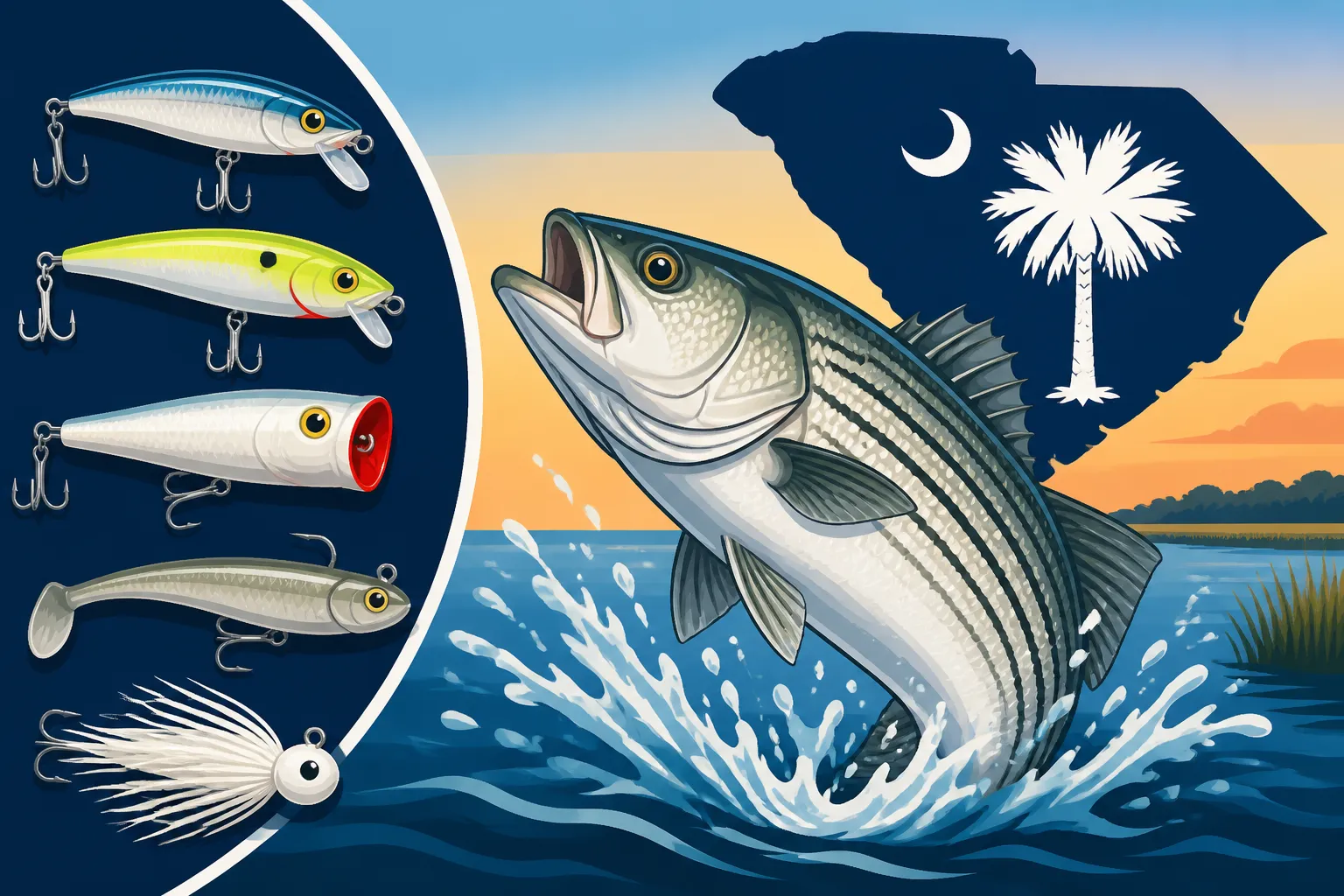
Poppers and walk-the-dog style lures are phenomenal for drawing aggressive strikes from stripers. Poppers, with their cupped faces, create a loud "bloop" or "pop" sound when retrieved, splashing water and imitating a struggling baitfish on the surface. Lures like the Heddon Super Spook or the Zara Spook are classic walk-the-dog baits, known for their side-to-side gliding action that can drive stripers wild. The key to these lures is to impart a rhythmic retrieve, making them "walk" across the water. It takes a little practice, but once you get the cadence down, the results can be spectacular.
For example, imagine a calm morning on Lake Wateree. The sun is just peeking over the horizon, and you see splashes in the distance – tell-tale signs of stripers busting bait. Tossing a chrome-colored Zara Spook into the fray, you start a steady, wrist-snapping retrieve, making the lure dance from side to side. Suddenly, the water erupts, and your rod bends violently as a hungry striper engulfs the lure. The adrenaline rush is unmatched! These lures are particularly effective in low-light conditions or when stripers are actively herding baitfish near the surface. You can find a fantastic selection of these classic topwater lures on Amazon, ensuring you're ready for those explosive moments.
Pencil Poppers and Spooks
Pencil poppers offer a slightly different action than traditional poppers. Their elongated, slender bodies allow for long casts, and when retrieved with a sweeping rod motion, they create a distinct "splashing and chugging" surface disturbance. This mimics a larger, frantic baitfish trying to escape. They are especially popular for larger stripers and often shine when targeting fish that are a bit more spread out or feeding on bigger prey. Spooks, as mentioned earlier, are also top contenders, offering a more subtle, gliding action that can be irresistible when stripers are being finicky.
When you're fishing a long point on Lake Murray in the spring, and you see some surface activity but the fish aren't committing to smaller baits, a larger pencil popper might be exactly what you need. Its ability to cover water and create a significant commotion can call in stripers from a greater distance. It's a game of attraction, and these lures are masters of it. The key is to experiment with your retrieve speed and pause duration. Sometimes a slow, steady "walk" with a few short pauses is all it takes; other times, a rapid, erratic splash is what triggers the bite. For some excellent spring and fall techniques, consider reading Lake Hartwell Spring and Fall Bass Fishing Patterns in South Carolina.
Subsurface Lures: The Versatile Workhorses
While topwater action is thrilling, subsurface lures are often the most consistent producers for South Carolina striped bass, especially when the fish are holding a bit deeper or not actively feeding on the surface. These lures cover a wide range of depths and retrieve styles.
Jerkbaits and Swimmbaits
Jerkbaits are designed to imitate a wounded baitfish with an erratic, darting action. They are particularly effective when stripers are keying in on slender baitfish like herring or shad. The "rip, rip, pause" retrieve is standard: two quick jerks of the rod tip, then a pause, letting the bait suspend or slowly float up, often triggering a strike on the pause. Swimmbaits, on the other hand, offer a more natural, undulating swimming action. These soft or hard plastic lures often have a paddle tail or segmented body that creates a lifelike movement in the water.
Imagine fishing the bends of the Congaree River. The current is steady, and you suspect stripers are holding near submerged structure. Casting a long, slender jerkbait upcurrent and working it back with a series of jerks and pauses allows it to drift naturally while exhibiting that injured baitfish look. Or, perhaps you're targeting larger stripers in the Santee Cooper lakes; a realistic swimbait, retrieved steadily or with a stop-and-go motion, can be incredibly effective at mimicking a cruising shad. The versatility of these lures makes them a must-have. Don't forget to keep a selection of various sizes and colors in your tackle box.
Crankbaits and Lipless Crankbaits
Crankbaits are fantastic for covering water and targeting specific depths. Deep-diving crankbaits can reach stripers holding in thermoclines or near submerged humps, while shallower models are great for targeting flats or points. Their aggressive wobble and vibration can draw strikes from active fish. Lipless crankbaits are particularly versatile; they sink quickly and can be retrieved at any depth, making them excellent for schooling fish or when you need to cover a lot of water quickly. Their tight wiggle and rattling sound are irresistible to many stripers.
Let's say you're out on Lake Greenwood, exploring new territory for stripers. Trolling a deep-diving crankbait along a drop-off can help you locate schools of fish. Once you find them, you can switch to casting a lipless crankbait, ripping it through the school and letting it flutter on the fall. This aggressive presentation often triggers a reaction strike. The key with crankbaits is to experiment with different sizes, colors, and retrieve speeds until you find what the stripers are responding to that day. Many anglers swear by shad-patterned crankbaits as a year-round staple.
Deep Water Lures for Trolling and Vertical Jigging
When South Carolina's summer heat drives stripers deep, or when they're schooling in the colder months in the vast depths of our reservoirs, specialized deep-water lures become indispensable. Trolling and vertical jigging are highly effective techniques for reaching these elusive fish.
Bucktail Jigs and Metal Spoons
Bucktail jigs are perhaps the most classic and versatile deep-water striper lure. Their simple design, consisting of a lead head molded with deer hair, creates a lifelike pulsing action in the water. They can be jigged vertically, cast and retrieved with a rhythmic bounce, or even trolled. Adding a soft plastic trailer can enhance their appeal. Metal spoons, like Kastmasters or Hopkins Shorties, are also excellent for deep-water jigging. Their flash and flutter on the fall perfectly mimic a dying baitfish, a sight stripers find hard to resist.
Imagine you're on Lake Murray in July, and the stripers are holding 40-50 feet deep. You locate a school on your sonar over a submerged hump near Dreher Island. Dropping a heavy bucktail jig or a shiny metal spoon directly into the school and jigging it with sharp lifts and drops can provoke immediate strikes. The heavy lures get down quickly, allowing you to stay on the fish. For more on Lake Murray summer striper fishing, check out Lake Murray Summer Striped Bass Techniques in South Carolina. These lures are also fantastic when you're targeting Striped Bass Winter Fishing Patterns in Freshwater Lakes, as fish often hold deep during colder periods.
Umbrella Rigs and Sassy Shads
For those who embrace trolling, especially in large reservoirs, the umbrella rig is a striper magnet. This rig typically features a central weight with multiple wire arms, each adorned with soft plastic baits like Sassy Shads or swimbaits. It creates the illusion of a small school of baitfish, which is incredibly enticing to large, predatory stripers. Sassy Shads themselves are fantastic on their own, whether rigged on a jig head for casting or as part of a trolling spread. Their paddle tail generates a strong thumping action that appeals to stripers.
When you're trolling the open waters of Lake Marion or Lake Moultrie, covering vast expanses to find those roaming schools of stripers, an umbrella rig can be incredibly effective. Setting it at the right depth, often using downriggers or heavy inline weights, allows you to present a "school" of baits right in front of the stripers' noses. The visual presence of multiple baits triggers their competitive instinct. Meanwhile, a single Sassy Shad on a jig head cast to busting fish or worked along a drop-off can also be highly productive. You can always find a wide selection of Sassy Shads and other soft plastics on Amazon to keep your tackle box stocked.
Live Bait and Soft Plastics: When to Go Natural
While artificial lures are incredibly effective, sometimes nothing beats the real thing, or a very convincing imitation. Live bait and soft plastics offer a different presentation that can be deadly when stripers are wary or less active.
Live Bait: Herring and Shad
For many seasoned South Carolina striper anglers, live bait is the ultimate weapon, especially for targeting trophy-sized fish. Live blueback herring, threadfin shad, or gizzard shad are irresistible to stripers. The natural movement, scent, and distress signals of a live baitfish are often enough to trigger a strike when artificials fail. These are typically fished on a free-line, under a balloon, or on a downrigger to present them at the desired depth.
Consider a situation on the Savannah River where stripers are cruising deep or just suspended and not reacting to lures. Dropping a frisky live herring into their vicinity, allowing it to swim naturally, can be the ticket to a hook-up. The key is fresh, lively bait. Keeping them alive and active requires a good livewell and attention to water quality. This method often requires patience but can yield some of the largest stripers. While you can't buy live bait directly from Amazon, the platform offers all the essential equipment like aerators and livewell accessories to keep your bait in prime condition.
Soft Plastics: Flukes and Swimbaits
Soft plastics have evolved dramatically and now offer incredibly realistic imitations of baitfish. Flukes, with their darting, erratic action when twitched, are excellent for mimicking dying shad or herring. Rigged weightless or with a small weight, they can be incredibly versatile in various depths. Soft plastic swimbaits, with their lifelike swimming motion, can be retrieved steadily or jigged, presenting a very natural profile. These lures are quieter than hard baits and can be very effective in clear water or when fish are pressured.
Imagine fishing a tidal creek along the South Carolina coast, looking for stripers holding in ambush points. Casting a white or pearl-colored fluke near structure and twitching it subtly can often draw strikes from wary fish. Or, in a clear lake, a realistic soft plastic swimbait, fished slowly along a weed line, might be the only thing they'll touch. The beauty of soft plastics is their versatility in rigging and presentation. They can be Texas-rigged, Carolina-rigged, or fished on a jig head, allowing you to adapt to almost any condition.
Matching Lures to South Carolina's Diverse Striper Fisheries
South Carolina boasts a fantastic variety of striped bass fisheries, each with its unique characteristics. The lakes are different from the rivers, and even coastal brackish waters demand slightly different approaches. The best lure choice often depends on where you are fishing.
Freshwater Lake Strategies: Murray, Hartwell, Santee Cooper
South Carolina's major freshwater impoundments like Lake Murray, Lake Hartwell, and the Santee Cooper lakes (Marion and Moultrie) are renowned for their robust striped bass populations. In these vast waters, covering ground and matching the prevalent baitfish is paramount.
For schooling fish in open water, especially during active feeding periods, topwater lures like pencil poppers or walk-the-dog baits are excellent. When stripers are holding deeper, particularly in summer or winter, vertical jigging with bucktails or metal spoons, and deep trolling with umbrella rigs or large crankbaits, are highly effective. On Lake Murray, for instance, anglers often troll umbrella rigs over submerged humps and ledges, while on Lake Hartwell, bass-style crankbaits and swimbaits mimic the abundant blueback herring. For specific strategies on these famous waters, you can explore Striped Bass Fishing on Lake Murray, South Carolina or Lake Hartwell Striped Bass Fishing Spots. The sheer size of these lakes means you'll often be using electronics to find schools before deploying your lures.
| Lure Type | Best for Season/Condition | Typical Depth | Examples |
|---|---|---|---|
| Topwater Poppers | Spring/Fall, low light | Surface | Heddon Super Spook, Zara Spook |
| Jerkbaits | Spring/Fall, clear water | 2-10 feet (suspends) | Rapala X-Rap, Lucky Craft Pointer |
| Lipless Crankbaits | All seasons, searching | Variable (fast sink) | Rat-L-Trap, Bill Lewis Lures |
| Deep Crankbaits | Summer/Winter, deep water | 15-30+ feet | Strike King XD Series, Rapala DownDeep |
| Bucktail Jigs | All seasons, vertical jig | Variable (bottom) | SPRO Bucktail Jig, Andrus Jetty Caster |
| Metal Spoons | All seasons, vertical jig | Variable (mid-depth) | Kastmaster, Hopkins Shorty |
| Soft Plastic Swimbait | All seasons, natural presentation | Variable | Keitech Swim Impact, Zoom Super Fluke |
| Umbrella Rig | Trolling, open water | Variable (with weight) | YUM Flash Mob Rig, Mann's Bait Company |
River and Estuary Tactics: Coastal Rivers and Tributaries
South Carolina's tidal rivers and estuaries, from the Cooper River to the Edisto River, offer a different kind of striper fishing. Here, current, tide, and structure play a much more significant role. Stripers in these environments are often more migratory, moving up and down with the seasons and tides.
In these waters, soft plastics like paddletail swimbaits rigged on jig heads are incredibly versatile, allowing you to work current seams and around docks or oyster bars. Bucktail jigs are also phenomenal for probing deeper holes and ledges in the current. During periods of active feeding, particularly around ambush points or jetties, topwater lures can still draw strikes. Live bait, especially shrimp or mud minnows in the brackish zones, can also be very effective. Understanding Striped Bass Migration Up South Carolina's Coastal Rivers is crucial for timing your trips here. The narrow confines of rivers often mean shorter casts and more precise lure placement are required compared to vast lakes.
Adapting to Coastal and Brackish Waters
While stripers are primarily a freshwater target in South Carolina, they do venture into brackish and even saltwater environments, especially in the cooler months or during their spawning runs. In these coastal transitional zones, the lines between freshwater and saltwater lures can blur. Many of the same soft plastics and bucktail jigs that work in freshwater will also work here, but you might also incorporate lures designed for saltwater species like redfish or speckled trout. For example, a popping cork with a soft plastic shrimp imitation might entice a striper in a brackish marsh. Similarly, a twitchbait that works for trout can also be effective. The key is to pay attention to the salinity and the types of baitfish present. Always check the current Saltwater Fishing Rules in South Carolina and South Carolina's Freshwater Fishing Regulations as the specific rules for striped bass can sometimes vary by location and whether you're in fresh or saltwater.
Ultimately, the "best" lure for striped bass in South Carolina isn't a single item; it's a dynamic choice based on the season, water body, prevailing conditions, and the stripers' current mood. Keep an open mind, observe your surroundings, and don't be afraid to experiment with your tackle box. Happy fishing!
Disclaimer
This article is for general informational purposes only and does not constitute professional advice. Laws, prices and regulations vary by location and change over time. Consult a qualified professional for guidance on your specific situation.