How to Identify a Flounder’s Eyes
One of the most fascinating challenges for any angler in South Carolina, especially those new to coastal fishing, is correctly identifying a flounder. These masters of camouflage blend so perfectly into the sandy or muddy bottom that telling one species from another, or even if it's a keeper, can feel like a secret handshake. This guide is here to demystify the art of identifying a flounder, focusing specifically on how their incredibly unique eyes can give away their identity.
The Marvel of Flounder Eyes: A Unique Adaptation
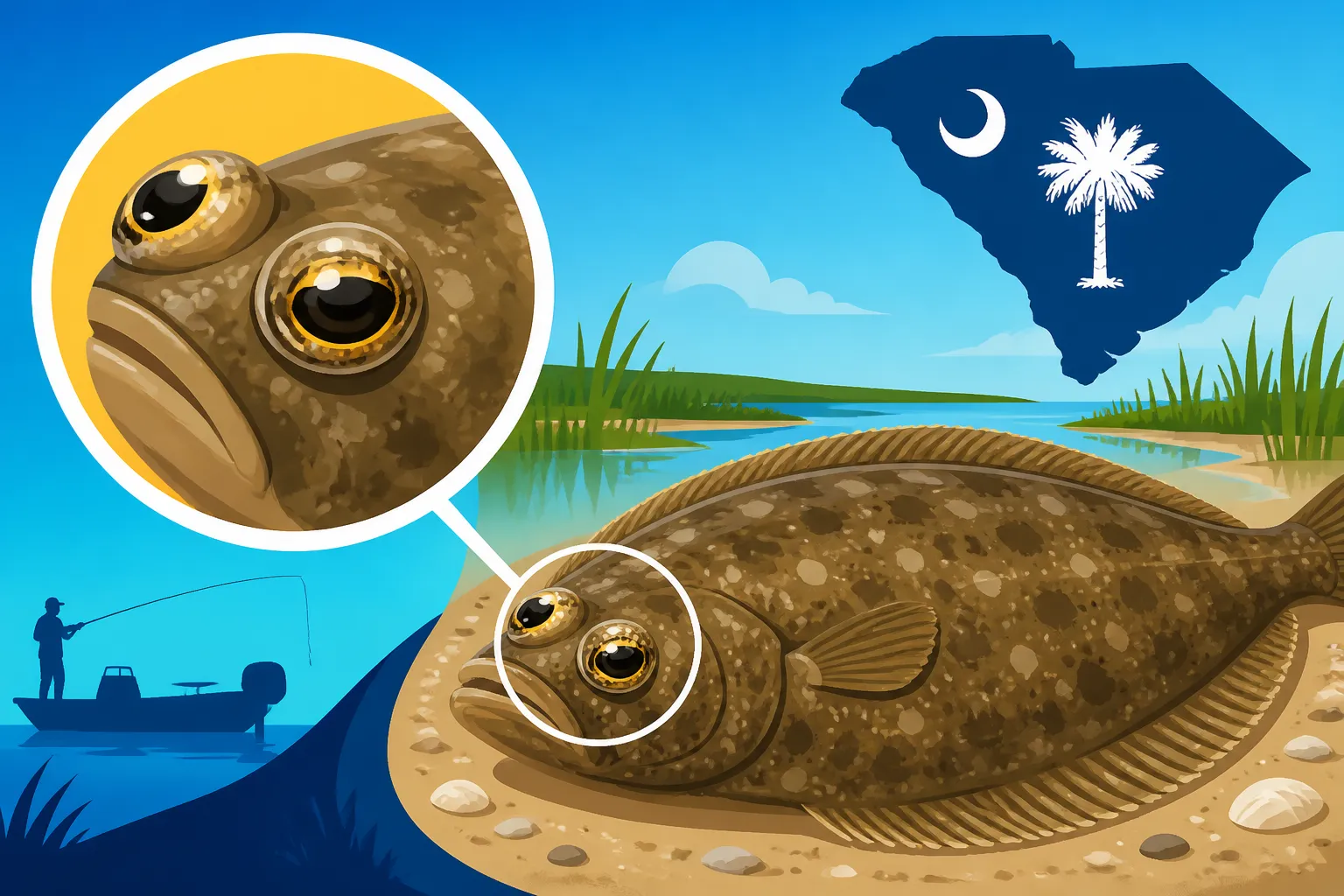
Flounder are truly one of nature's most bizarre and brilliant creations. Unlike most fish that have an eye on each side of their head, flounder are flatfish, meaning they lie on one side. This lifestyle led to an incredible evolutionary journey where one eye actually migrates across the top of their head to join the other on what becomes their "upward-facing" side. This migration is complete by the time they are juveniles, giving them the distinct appearance we all recognize.
The Phenomenon of Eye Migration
It’s hard to imagine, isn’t it? A baby flounder starts life looking much like any other fish, with an eye on each side of its head. But as it grows and begins to flatten out, one eye slowly, almost magically, shifts its position. This incredible adaptation allows the flounder to lie flat on the seabed, perfectly camouflaged, while still having both eyes scanning upwards for prey and predators. It’s a marvel of natural engineering, helping them survive and thrive in their unique benthic environment. Understanding this journey helps us appreciate why their eyes are so crucial for identification.
Why Eye Placement Matters for Identification
For anglers, understanding this eye placement is more than just a cool biological fact; it’s a critical identification tool. The direction of this eye migration is often consistent within certain species, meaning some flounder species are typically "left-eyed" and others are "right-eyed." This characteristic can be a definitive marker, helping you differentiate between similar-looking species when you're out on the water. It’s a quick, visual clue that can prevent misidentification, especially when regulations vary by species.
South Carolina Flounder Species and Their Eye Characteristics
South Carolina's coastal waters are home to a few different species of flounder, and knowing their typical eye orientation can be a huge help when you're trying to figure out exactly what you’ve caught. The most commonly encountered species are the Southern Flounder, Gulf Flounder, and Summer Flounder. Each has its own general rule for eye placement, though nature, being nature, occasionally throws in an anomaly.
Southern Flounder: The Common Left-Eyed Resident
The Southern Flounder ( Paralichthys lethostigma) is perhaps the most common flounder species you’ll encounter along the South Carolina coast, especially in our inshore estuaries and nearshore waters. These fish are typically "left-eyed." What does that mean exactly? If you lay the flounder on its dark, pigmented side with its belly toward you and its head pointing left, both eyes will be on the top of its head, facing upwards. This is the general rule for Southern Flounder, and it's a strong indicator.
You’ll often find Southern Flounder hiding in muddy creek bottoms, around oyster rakes, or near structure. Their drab, mottled coloration helps them disappear against these backdrops. When you reel one in, take a moment to gently hold it and observe its head. Confirming that both eyes are indeed on the left side of its body, when oriented correctly, can instantly tell you a lot about your catch. Remember, proper identification is key to adhering to South Carolina Redfish Slot Limit Rules and other regulations.
Gulf Flounder: Another Left-Eyed Neighbor
The Gulf Flounder (Paralichthys albigutta) also calls South Carolina waters home, though perhaps less frequently encountered than the Southern Flounder in some areas. Like their Southern cousins, Gulf Flounder are predominantly "left-eyed." This means their eyes are also on the left side of their body when viewed from the dark, pigmented side, head pointing left.
While both Southern and Gulf flounder share the left-eyed trait, there are other subtle differences in their coloration and spot patterns that help distinguish them. Gulf Flounder often have three distinct, ocellated (eye-like) spots forming a triangle on their body, which Southern Flounder typically lack. These spots are usually quite dark and ringed with a lighter color. So, once you've confirmed the left-eyed orientation, looking for these "target" spots can further help with identification. It's like a double-check system that nature provides.
Summer Flounder (Fluke): The Right-Eyed Exception
Now, here’s where things get interesting and where careful observation really pays off. The Summer Flounder (Paralichthys dentatus), often called "Fluke" further north, is the primary "right-eyed" flounder species you might encounter in South Carolina. This means that if you orient the fish with its dark side up, belly toward you, and head to the left, its eyes will be on the right side of its head. This is the exact opposite of the Southern and Gulf Flounder!
Summer Flounder are typically found in slightly cooler, clearer waters than Southern Flounder, often moving further offshore or to deeper inshore areas in the summer months. They also tend to have a lighter, more varied coloration with numerous dark spots that extend onto their fins, and their tail often has a distinct, concave shape. Learning to quickly spot whether a flounder is left-eyed or right-eyed is your first, best step in distinguishing these species. This is particularly important when considering Flounder Fishing Season in South Carolina or specific regulations that might apply.
Anomalies and How to Handle Them
While the "left-eyed" rule for Southern and Gulf flounder and the "right-eyed" rule for Summer flounder are generally reliable, it's important to remember that nature can produce exceptions. Occasionally, you might encounter a Southern Flounder that is right-eyed, or a Summer Flounder that is left-eyed. These are known as reversal anomalies, and while rare, they do occur.
If you catch a flounder that seems to defy the typical eye orientation for its other visual characteristics, it can be a head-scratcher. In such cases, it's best to rely on a combination of factors: overall body shape, coloration, fin patterns, and specific spot markings. If you're ever in doubt about the species or its legality, the safest bet is always to release the fish. A good waterproof fish identification guide, perhaps one you ordered from Amazon, can be an invaluable tool for these tricky situations.
To help visualize these differences, here’s a quick overview:
| Flounder Species | Typical Eye Orientation | Key Distinguishing Marks | Common Habitat in SC |
|---|---|---|---|
| Southern Flounder | Left-eyed | Drab, mottled, uniform color; no distinct spots. | Muddy creek bottoms, oyster rakes, estuaries, nearshore. |
| Gulf Flounder | Left-eyed | Three distinct, ocellated (eye-like) spots on body. | Sandy bottoms, slightly clearer water than Southern. |
| Summer Flounder (Fluke) | Right-eyed | Lighter, variable coloration; many dark spots on body and fins; concave tail. | Cooler, clearer inshore and offshore waters. |
Why Correct Eye Identification Is So Crucial for Anglers
You might be thinking, "Why bother with all this eye talk? A flounder is a flounder, right?" Well, not exactly, especially here in South Carolina. There are very good reasons why being able to identify a flounder down to its specific species is incredibly important for responsible angling.
Adhering to Size and Bag Limits
This is probably the biggest reason. Different species of flounder often have different size and bag limits. For instance, the regulations for Southern Flounder might be different from those for Summer Flounder. If you misidentify your catch, you could inadvertently keep an undersized fish or exceed the daily bag limit for that particular species, leading to potential penalties. Knowing South Carolina Flounder Fishing Regulations Explained is paramount for every angler.
Conservation efforts are often species-specific, and these regulations are put in place to protect particular populations. Anglers are on the front lines of conservation, and our adherence to these rules directly impacts the health of the fishery for future generations. It’s not just about avoiding a fine; it’s about being a good steward of our natural resources.
Understanding Habitat and Behavior
Knowing which species you're targeting or have caught can also tell you a lot about its preferred habitat and behavior. For example, if you're consistently catching left-eyed flounder in a muddy creek, you can confidently assume you're in prime Southern Flounder territory and adjust your techniques accordingly. If you move to a clearer, deeper area and start catching right-eyed flounder, you know you've found a Summer Flounder hotspot.
This knowledge helps you become a more effective angler. You can refine your bait choices, lure presentations, and even your approach to specific locations. It informs your understanding of where to find the fish based on water conditions, bottom structure, and even the time of year. For instance, knowing you're targeting Southern Flounder might lead you to focus on Flounder Fishing Spots Along South Carolina's Barrier Islands that feature more muddy bottoms.
Contributing to Conservation Efforts
Every piece of information you gather about your catch, even if just for your own knowledge, can contribute to the bigger picture of conservation. Fishery biologists rely on angler data and observations to monitor fish populations and manage our resources. While you might not be formally reporting every catch, your personal understanding of what you're catching and where enhances the collective knowledge.
Furthermore, accurately identifying species ensures that if a particular species is under stricter conservation measures or even catch-and-release only, you can make the right decision. This kind of detail is something often covered in comprehensive South Carolina Fishing Charters: The Complete Guide offered by knowledgeable local captains who prioritize sustainable fishing practices.
Practical Tips for Identifying Flounder Eyes in the Wild
It's one thing to read about eye migration and left-eyed vs. right-eyed characteristics; it's another to apply it when you've got a live, flapping flounder in your hands. But with a little practice and some simple techniques, you'll be a pro at flounder eye identification in no time.
Gentle Handling for Closer Inspection
The first and most important tip is to handle the fish gently. Flounder have sharp teeth, so be careful! If you’re going to inspect its eyes closely, use a fish gripper or a wet towel to hold it securely without harming it or yourself. Avoid squeezing the fish, especially around its midsection. The goal is a quick, safe identification, not to stress the fish.
Once you have it secure, lay it flat on its dark, pigmented side (the side that was facing up in the water) on a cool, wet surface, like your boat's deck or a measuring board. Orient its head to your left. Now you can clearly see if both eyes are on the "left" side or the "right" side of its body. This gentle approach also helps ensure a successful release if the fish is undersized or not the target species.
Using Visual Aids (If Needed)
Sometimes, especially in low light or if you're just learning, it can be hard to clearly see the eye placement. This is where a few simple tools can come in handy. A small magnifying glass, readily available on Amazon, can help you get a clearer view of the eyes and other subtle features like scale patterns or specific spots. Even a good headlamp, also available through retailers like Amazon, can make a huge difference if you're fishing at dawn, dusk, or night. Remember, a quick and accurate identification prevents unnecessary stress on the fish.
Another great visual aid is a detailed, waterproof fish identification card or book. Keep one handy in your tackle box. These guides often have clear illustrations or photos showing the different flounder species found in your area, highlighting their key identification features, including eye orientation. This is much better than trying to Google something with wet, fishy hands!
Practice Makes Perfect
Like any fishing skill, identifying flounder by their eyes gets easier with practice. Every flounder you catch is an opportunity to refine your observation skills. Even if you're sure you've got a Southern Flounder, take a moment to confirm its left-eyed status. If you catch one with spots, double-check that it’s still left-eyed and confirm the species. The more you consciously practice, the more intuitive it will become.
Don't be afraid to take a quick, clear photo (without flash, to protect the fish's eyes) of your catch if you're unsure and want to consult a guide or an experienced angler later. Many online fishing forums are great places to ask for identification help. Just remember to release any questionable fish safely and quickly. Mastering this skill will not only make you a more responsible angler but also deepen your appreciation for the incredible diversity of South Carolina Fish Species: A Complete Guide to What's in the Water.
Disclaimer
This article is for general informational purposes only and does not constitute professional advice. Laws, prices and regulations vary by location and change over time. Consult a qualified professional for guidance on your specific situation.