What Does a Sauger Look Like Compared to a Walleye?
It's happened to the best of us: you're out on a South Carolina lake, reeling in what you think is a fantastic walleye, only to pull it closer and start second-guessing yourself. Is it a walleye? Or is it its slightly smaller, sometimes trickier cousin, the sauger? This confusion is incredibly common, and understanding the subtle (and sometimes not-so-subtle) differences between these two fantastic fish can save you from a lot of head-scratching – and potential regulatory headaches. This guide is here to walk you through exactly what to look for, helping you confidently identify your catch every single time.
The Core Challenge: Why Anglers Confuse Sauger and Walleye
It’s completely understandable why so many anglers, even seasoned ones, find themselves staring at a fish in their hands wondering if it's a walleye or a sauger. On first glance, they share a striking resemblance, almost like siblings in the same family. Both are members of the perch family, and both are predatory, preferring similar habitats and often found in the same waters, especially across our beautiful state of South Carolina. This genetic closeness and habitat overlap are the primary reasons for the frequent mix-ups.
Shared Characteristics and Habitat Overlap
Picture this: you're casting into a murky, slightly deeper section of a river or a large reservoir in South Carolina, perhaps on the edge of a drop-off or near some submerged structure. This is prime real estate for both walleye and sauger. They both thrive in cooler, deeper water, often where there's a bit of current or some turbidity that offers them camouflage. Their torpedo-shaped bodies, large mouths, and sharp teeth are all adaptations for their predatory lifestyle, allowing them to ambush smaller baitfish. From a distance, or in low light conditions, that general olive-brown to golden coloration with darker mottling can easily lead one to believe they've caught one or the other without a closer look. They're built for speed and efficiency in their aquatic environment, and these shared physical traits make the initial identification a real head-scratcher.
When you bring one of these fish into the boat, you'll immediately notice that signature "glassy" or "walleye" eye shine, a result of a reflective layer called the tapetum lucidum. This adaptation helps both species see in low-light conditions, giving them a distinct advantage over their prey during dawn, dusk, or in deeper, darker waters. This common trait, combined with their general body shape and similar overall color palette, creates a perfect storm for misidentification. It's like trying to tell two very similar-looking cars apart in the dark; you need to focus on the fine details.
Importance of Accurate Identification for Regulations
Beyond just knowing what you caught (which is satisfying in itself!), correctly identifying a sauger versus a walleye is absolutely crucial for staying on the right side of the law. South Carolina, like many states, has specific regulations that often differ between these two species, particularly regarding size limits and daily bag limits. Catching a fish that's technically a walleye but mistaking it for a sauger (or vice-versa) could land you in hot water if you're not adhering to the correct rules. Imagine having a successful day on the water, only to find out you've inadvertently violated a fishing regulation because of a simple ID mistake. That's a frustrating scenario we all want to avoid.
Fisheries management relies on these distinct regulations to maintain healthy populations of both species. Walleye, for instance, might have a higher minimum size limit or a more restrictive bag limit than sauger in certain areas or at certain times of the year, especially if one population is more sensitive or less abundant. Anglers have a responsibility to know the rules, and the first step to compliance is accurate identification. It's not just about avoiding a Penalty for Fishing Without a License in South Carolina, but also about being a responsible steward of our natural resources. Always double-check the latest South Carolina Fishing Bag Limits Explained for the specific body of water you're fishing.
Spotting the Differences: Key Visual Cues
Alright, let’s get down to the nitty-gritty. When you've got one of these beauties in your hand, what are the definitive visual cues that will tell you if it’s a sauger or a walleye? While they share many similarities, there are several key features that, once you know them, make identification much clearer.
Dorsal Fin Distinctions: Spots vs. Bands
This is arguably the most reliable and easiest way to tell a sauger from a walleye. Just focus on that first, spiny dorsal fin.
For the sauger, you’ll notice distinct, round, black spots arranged in neat rows across the entire membrane of its first dorsal fin. It looks almost like a dotted pattern or a series of small, dark freckles. These spots are usually quite prominent and evenly distributed, giving the fin a speckled appearance. There's generally no large, solid blotch at the back. It’s a clear, unmistakable visual marker that truly sets it apart. If you see those perfectly formed rows of spots, you've likely got a sauger.
Now, for the walleye, the first dorsal fin tells a different story. Instead of individual spots, the walleye’s first dorsal fin typically has a more uniform, often subtly striped or banded appearance, but the absolute giveaway is a prominent, dark, opaque blotch at the very rear base of this spiny fin. It's a solid black patch that stands out against the rest of the fin. While some walleye might have very faint mottling or dark streaks on their dorsal fins, they will almost never have the clear, distinct rows of black spots that are characteristic of the sauger. Think of it as a thumbprint – that black blotch is the walleye's signature.
Body Markings and Coloration
While both fish have a somewhat mottled appearance, a closer look at their bodies reveals another crucial distinction in their patterning and overall hue.
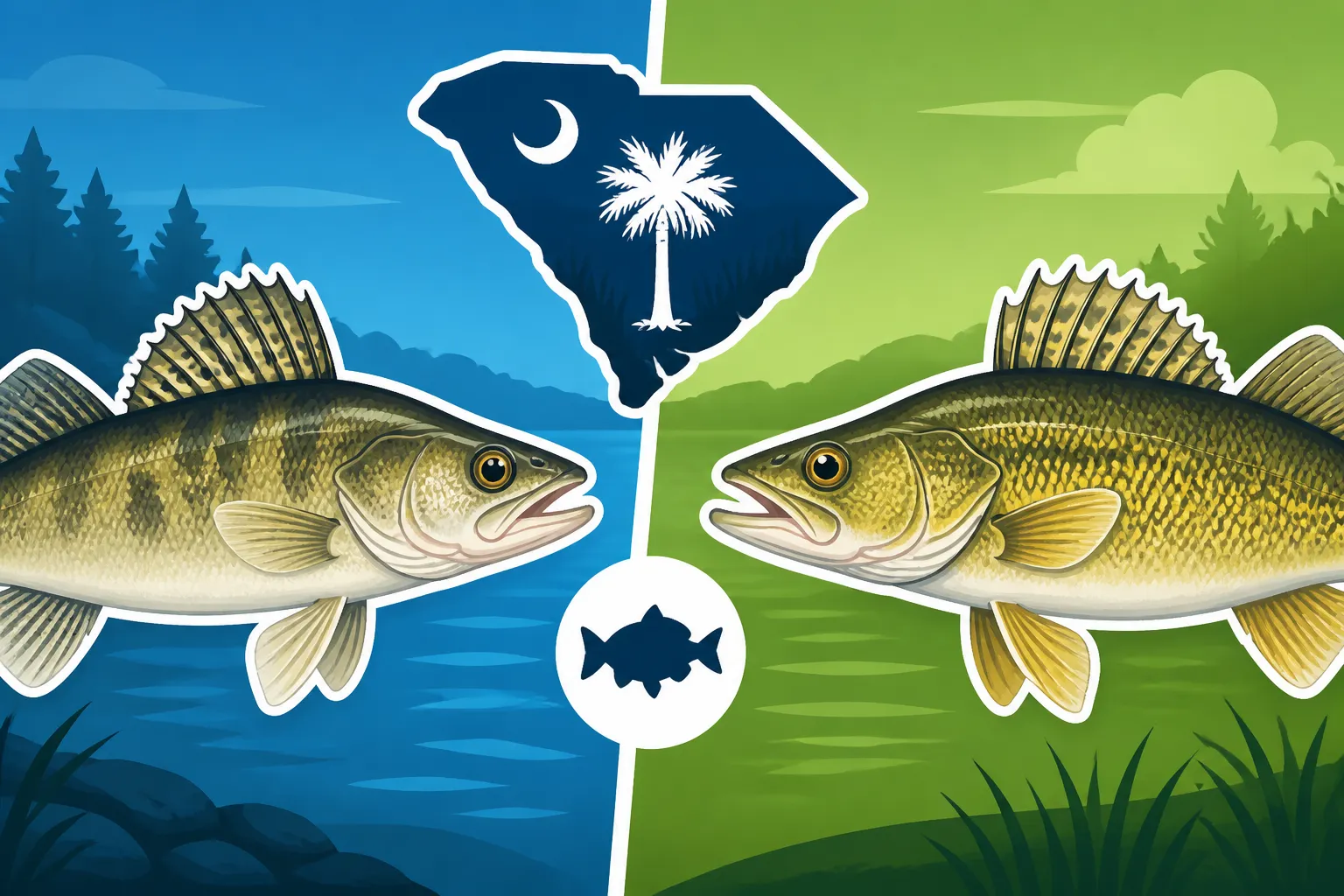
The sauger typically displays more pronounced and irregular blotchy, saddle-like markings along its sides. These dark blotches tend to extend down from the back, almost draped over its back and sides, creating a more camouflaged, almost tiger-striped look. The overall body coloration of a sauger often leans towards a brassier, more olive-brown, or sometimes even a silvery-bronze tone, especially when caught from turbid waters. This heavier, more distinct pattern helps them blend into varied river bottoms and structure. If you're looking for an example of this, many online fishing forums and identification guides, or even fish identification posters you can buy on Amazon, will clearly show these contrasting patterns.
The walleye, on the other hand, generally has a more uniform body coloration. Its sides are typically a golden-olive, greenish-brown, or even a yellowish-gold, often with subtle, less defined vertical bars or mottling that can sometimes fade almost completely. While they aren't plain, their markings are usually much less pronounced and do not form the distinct "saddles" you see on a sauger. The walleye's overall appearance tends to be sleeker, with less visual "busyness" on its flanks. Think of the sauger as having a bolder, more rugged pattern, while the walleye is a bit more understated in its primary coloring.
Tail Fin and Pectoral Fin Peculiarities
Don't forget to examine the fins beyond the dorsal! The tail fin (caudal fin) offers another excellent distinguishing feature, especially for walleye.
The walleye possesses a very distinct and easily identifiable white tip on the lower lobe of its caudal fin. This white patch is often quite bright and stands out clearly, making it an excellent field mark. It’s a consistent characteristic that anglers rely on heavily. This white tip is one of those small details that makes a huge difference in identification.
The sauger generally lacks this prominent white tip on its lower caudal fin lobe. Its tail fin will typically be mottled or spotted, matching its body coloration, or simply translucent with no distinct white patch. If there is any lighter coloration, it’s usually much fainter and less defined than the walleye’s crisp white tip. As for pectoral fins, while less distinct, some sauger might have faint spots on these fins as well, a trait usually absent in walleye.
The Scales and Lateral Line
While perhaps not the first features you'd reach for in a quick identification, paying attention to the scales and the lateral line can offer corroborating evidence.
On a sauger, the scales on its body are typically smaller and might feel slightly rougher to the touch than a walleye's. The cheek scales (on the operculum, or gill cover) are usually fully scaled, meaning they extend all the way up to the eye. The lateral line, which runs down the side of the fish, is generally more prominent and can sometimes appear slightly wavy or broken up, blending into the blotchy patterns of the fish's body.
Conversely, the walleye tends to have larger, smoother scales. A key anatomical detail is that the walleye's cheek scales are often only partially scaled, or even entirely scaleless, especially towards the front near the eye. This is a subtle but consistent difference if you're willing to get up close and personal with your catch. The walleye's lateral line is typically straighter and more continuous, often highlighted by the more uniform body coloration around it. It's these subtle textural and coverage differences that can further confirm your initial dorsal and tail fin observations.
Head-to-Tail Analysis: Deeper Anatomical Details
Beyond the prominent fins and body patterns, a closer look at the head and mouth can provide additional clues, though these are often more subtle than the dorsal fin spots or tail tip. These details might require a bit more familiarity but can be helpful for those tricky cases.
Eye Characteristics and "Walleye" Glow
Both sauger and walleye are famous for their eyes, specifically the distinct "eyeshine" that gives the walleye its name. This phenomenon is due to a reflective layer behind the retina, the tapetum lucidum, which enhances their vision in low light.
For the walleye, this eyeshine is typically more pronounced and is often described as a glowing or glassy appearance. Their eyes are also generally quite large, aiding in their crepuscular (dawn and dusk) feeding habits. The position of their eyes, set relatively high on the head, allows for a wide field of vision to spot prey. This reflective quality is a major reason why they are so effective at hunting in deeper, murkier waters, or during those low-light periods when other fish are less active.
The sauger also possesses this reflective eye layer, so you'll still see an eyeshine, but it might appear slightly less intense or prominent than that of a walleye. Their eyes are also large, but sometimes appear a bit smaller in proportion to their head compared to a walleye. While not a definitive identifier on its own, when combined with other features, subtle differences in eye size and glow can contribute to the overall picture. Both species are designed for excellent vision in their preferred environments, which is why artificial lures that mimic baitfish eyes, readily available on platforms like Amazon, are so effective.
Mouth and Tooth Structure
When you examine the mouths of these two fish, you'll find they are both formidable predators, equipped with sharp, canine-like teeth. However, there can be subtle variations.
The walleye generally has a larger mouth overall, with the upper jaw extending back to, or slightly beyond, the middle of the eye. Their teeth are quite prominent and needle-sharp, arranged in rows, perfectly suited for grasping and holding onto slippery prey. The lower jaw might protrude slightly, giving them an aggressive, underslung appearance.
The sauger also has a well-armed mouth, but it might appear slightly smaller in proportion to its head compared to a walleye. The upper jaw typically does not extend quite as far back, usually ending before the middle of the eye. While still possessing sharp teeth, they might be perceived as marginally smaller or less robust than a walleye's. These are very subtle differences, and unless you're examining them side-by-side regularly, they can be tough to discern quickly. It's more of a confirming detail rather than a primary identifier.
Gill Cover and Opercle Markings
Moving to the side of the head, the gill cover (opercle) can provide another minor clue for discerning between the two species. This is a more advanced identification trick, but for those who love to dive deep into fish anatomy, it's worth noting.
The walleye typically has a smooth or mostly smooth opercle, with no noticeable sharp spines or scales covering the entire cheek area. As mentioned earlier regarding scales, the walleye's cheek is often sparsely scaled or even bare, especially on the front half.
The sauger, on the other hand, tends to have a more fully scaled opercle, meaning the scales extend further forward onto the cheek area. You might also notice a slight rougher texture or even a very small, sharp spine on the posterior margin of the opercle, though this can be variable and isn't always present or prominent enough to be a surefire identifier. Again, these are details that add to the puzzle, rather than being stand-alone solutions, but they reinforce the distinct genetic pathways these two species have followed.
Practical Tips for Anglers in South Carolina
Fishing in South Carolina offers fantastic opportunities to catch both walleye and sauger, especially in our larger reservoirs and rivers. Being prepared to identify your catch quickly and accurately is part of being a responsible and successful angler.
Best Practices for Field Identification
When you land a fish that you suspect might be either a walleye or a sauger, don't just guess! Take a moment for a proper field identification. First, always make sure your hands are wet before handling any fish you intend to release. This helps protect their slime coat, which is vital for their health. Gently hold the fish and immediately look at that first dorsal fin. Do you see distinct rows of black spots (sauger) or a large black blotch at the rear base (walleye)? That’s your primary clue.
Next, glance at the tail fin. Is there a crisp white tip on the lower lobe (walleye), or is it mottled like the rest of the fish (sauger)? These two features alone will correctly identify most fish. If you're still unsure, observe the body patterning – distinct saddles on the sauger, or more uniform golden-olive on the walleye? With practice, these visual checks become second nature, and you'll be able to tell the difference in seconds. A small, waterproof field guide kept in your tackle box, maybe one you picked up from Amazon, can also be invaluable for quick reference.
Using Resources and Local Knowledge
You are not alone in this quest for accurate fish identification! South Carolina has a wealth of resources available. The South Carolina Department of Natural Resources (SCDNR) website is an excellent starting point, often providing detailed illustrations and descriptions of various fish species, including South Carolina Freshwater Fish Species Worth Targeting. They also publish current South Carolina's Freshwater Fishing Regulations, which are essential reading before any fishing trip.
Don't underestimate the power of local knowledge. Chat with the folks at your local bait and tackle shop – they often have years of experience and can offer firsthand advice on what to look for in your specific fishing area. Fishing guides and charter captains are also a fantastic resource. Consider looking up information about Sauger Fishing in South Carolina: What Anglers Should Know or Is Walleye Fishing Good in South Carolina? to learn more about where and how these species are typically found in the state. Local fishing clubs and online forums for South Carolina anglers are also great places to ask questions and even post photos of your catch for identification help from experienced community members.
Why it Matters: Conservation and Compliance
At the end of the day, knowing the difference between a sauger and a walleye isn't just about showing off your fish ID skills; it's about being a responsible angler and contributing to the health of South Carolina's aquatic ecosystems. Adhering to specific size and bag limits for each species ensures that enough fish can reproduce and grow, maintaining sustainable populations for future generations of anglers. Ignoring these rules, even accidentally, can put undue pressure on fish stocks.
Moreover, failing to comply with fishing regulations can lead to citations, fines, and other penalties. Imagine spending money on a South Carolina Fishing License Guide and learning How to Get a Fishing License in South Carolina, only to run into trouble because you didn't correctly identify your catch. This diligence in identification ensures you're enjoying your fishing experience without the worry of breaking the law. Responsible fishing means understanding not just how to catch fish, but also how to protect them.
Here's a quick comparison table to help you keep track of the key differences:
| Feature | Walleye | Sauger |
|---|---|---|
| First Dorsal Fin | Large black blotch at the rear base. | Distinct rows of black spots across the membrane. |
| Tail Fin | Prominent white tip on the lower lobe. | No white tip; mottled or spotted. |
| Body Markings | More uniform golden-olive, subtle mottling. | Pronounced, irregular blotchy, saddle-like patterns. |
| Coloration | Golden-olive, greenish-brown, yellowish-gold. | Brassier, olive-brown, silvery-bronze. |
| Cheek Scales | Partially scaled or scaleless. | Fully scaled. |
| Overall Size | Generally larger and heavier. | Generally smaller and more slender. |
Disclaimer
This article is for general informational purposes only and does not constitute professional advice. Laws, prices and regulations vary by location and change over time. Consult a qualified professional for guidance on your specific situation.