Boat Fishing Techniques for Deep Water Bass
There's nothing quite as frustrating as heading out to your favorite South Carolina bass lake, ready for a fantastic day, only to find the bass have seemingly vanished. You hit all your usual shallow spots, throw your go-to topwaters and spinnerbaits, and come up empty. What gives? More often than not, those elusive bucketmouths have simply retreated to the cooler, more stable depths. This comprehensive guide will equip you with the knowledge and techniques needed to consistently find and catch bass hiding in deep water from the comfort of your boat, turning those frustrating days into successful ones.
The Deep Dive: Why Bass Seek the Depths in South Carolina Lakes
When the bite seemingly shuts down, especially during the warmer months or after a significant weather change, it's a sure sign that the bass have moved to deeper haunts. Understanding why they do this is the first crucial step to figuring out where to find them and how to catch them. It's not just about temperature; it's a complex interplay of factors that make deep water a more appealing sanctuary.
Thermal Stratification and Oxygen Levels
South Carolina's larger reservoirs, like Lake Murray or the Santee Cooper Lakes, experience significant thermal stratification, especially from late spring through early fall. This means the lake separates into distinct temperature layers: a warm upper layer (epilimnion), a rapidly changing middle layer (thermocline), and a cooler, more stable bottom layer (hypolimnion). Bass, being cold-blooded, are constantly seeking their preferred temperature range. During the brutal South Carolina summer, the surface water can become uncomfortably hot, pushing bass deeper into the cooler, more hospitable thermocline.
However, it's not just about staying cool. Oxygen levels play an equally vital role. While the deeper water might be cooler, the very bottom can become anoxic (lacking oxygen) due to decaying organic matter. This creates a "sweet spot" within or just above the thermocline where the water is both cool enough and oxygen-rich enough for bass to thrive. Anglers need to understand that simply finding the deepest part of the lake isn't enough; you need to find the habitable deep water, which is often a narrow band. This is where your electronics become invaluable, helping you identify that crucial thermocline depth, where you'll find a higher concentration of fish.
Forage and Cover: The Deep Water Pantry
Bass don't just hang out in deep water for comfort; they're predators, and they follow their food. Often, baitfish like threadfin shad and blueback herring will school up in these deeper, more stable temperature zones to avoid surface predators and find their own preferred environment. Where the baitfish go, the bass will follow. These baitfish schools become a deep-water pantry for bass, offering a consistent and often dense food source.
Beyond just food, deep water also offers excellent cover and structure, which is vital for ambush predators like bass. Submerged humps, deep ledges, brush piles, standing timber, and rock piles provide hiding spots for bass to ambush passing baitfish or simply to rest. Imagine a deep offshore hump on Lake Hartwell: it might be surrounded by 30-40 feet of water, but the top of the hump might come up to 15-20 feet, offering a perfect ambush point for bass positioned on its slopes or summit. Understanding these underwater topographic features and how they relate to the thermocline and bait concentrations is the key to unlocking consistent deep water success. You might even want to check out the guide on How to Fish Deep Structure for Bass in Summer to learn more about specific tactics for these scenarios.
Essential Arsenal for Deep Water Bass Anglers
Tackling deep water bass from a boat requires a different set of tools and a keen understanding of your equipment. You can't just rely on your shallow-water setup; you need specialized gear that allows you to effectively present baits at depth, detect subtle bites, and manage powerful fish in open water. Investing in the right equipment isn't just a luxury; it's a necessity for consistent success.
Rods, Reels, and Line Choices
When you're fishing deep, line capacity, sensitivity, and power become paramount. For deep cranking, a longer (7'6" to 8'0"), moderate-action rod is ideal. The moderate action helps with casting distance and allows the fish to load up on the crankbait without ripping the hooks out. Match this with a high-capacity baitcasting reel (like a 200-series model) with a slower gear ratio (around 5.0:1 to 6.2:1) to help with the retrieve resistance of deep-diving plugs and provide more winching power. For line, fluorocarbon is king. Its low stretch and invisibility in water make it perfect for deep presentations, allowing you to feel every bump and tick. A 10-15 lb test fluorocarbon is a good starting point for most deep cranking.
For techniques like dropshotting or fishing a Carolina rig, which demand extreme sensitivity, you'll want different setups. Dropshotting often calls for a longer (6'10" to 7'4"), medium-light to medium power, fast-action spinning rod paired with a sensitive spinning reel. Spool it with 6-10 lb braided line, tied to a 6-8 lb fluorocarbon leader. The braid provides unmatched sensitivity, while the fluorocarbon leader offers stealth. For Carolina rigging, a longer (7'0" to 7'6"), medium-heavy power, fast-action baitcasting rod with a fast retrieve ratio reel (7.0:1 or higher) is excellent for taking up slack line quickly and setting the hook on those subtle, deep bites. Again, fluorocarbon in 12-20 lb test is the preferred line for its sensitivity and abrasion resistance. Remember, the quality of your line, found on places like Amazon, can make a huge difference in feel and durability.
The Importance of Marine Electronics
If rods and reels are your weapons, then marine electronics are your eyes and ears underwater. You simply cannot consistently catch deep water bass without reliable sonar, side imaging, and GPS mapping. Modern fish finders from brands like Garmin, Humminbird, or Lowrance offer incredibly detailed views of the underwater world.
- 2D Sonar: This is your bread and butter for identifying fish arches, bait balls, and the crucial thermocline depth. Learn to distinguish between hard and soft bottom readings, and understand what different arch sizes might indicate.
- Down Imaging/ClearVü: Provides a picture-like view directly beneath your boat, making it easier to identify specific pieces of structure like individual logs, stumps, or rock piles.
- Side Imaging/SideVu: This technology is a game-changer for scanning wide swaths of water on either side of your boat. You can cover an incredible amount of area, pinpointing humps, ledges, brush piles, and even individual fish outside your boat's immediate footprint without driving right over them and spooking them. This helps you target specific cover and helps with Boat Positioning Techniques for Bass Fishing.
- GPS Mapping: Essential for marking waypoints once you find productive structure or active fish. It allows you to return to exact spots and effectively navigate complex underwater terrain. Pre-loaded high-definition mapping chips (like those from Navionics or C-MAP) can reveal contours, depth changes, and potential submerged features before you even get on the water, giving you a massive advantage. Practice interpreting these images on the water; it takes time, but it's an invaluable skill.
Must-Have Deep Water Lures
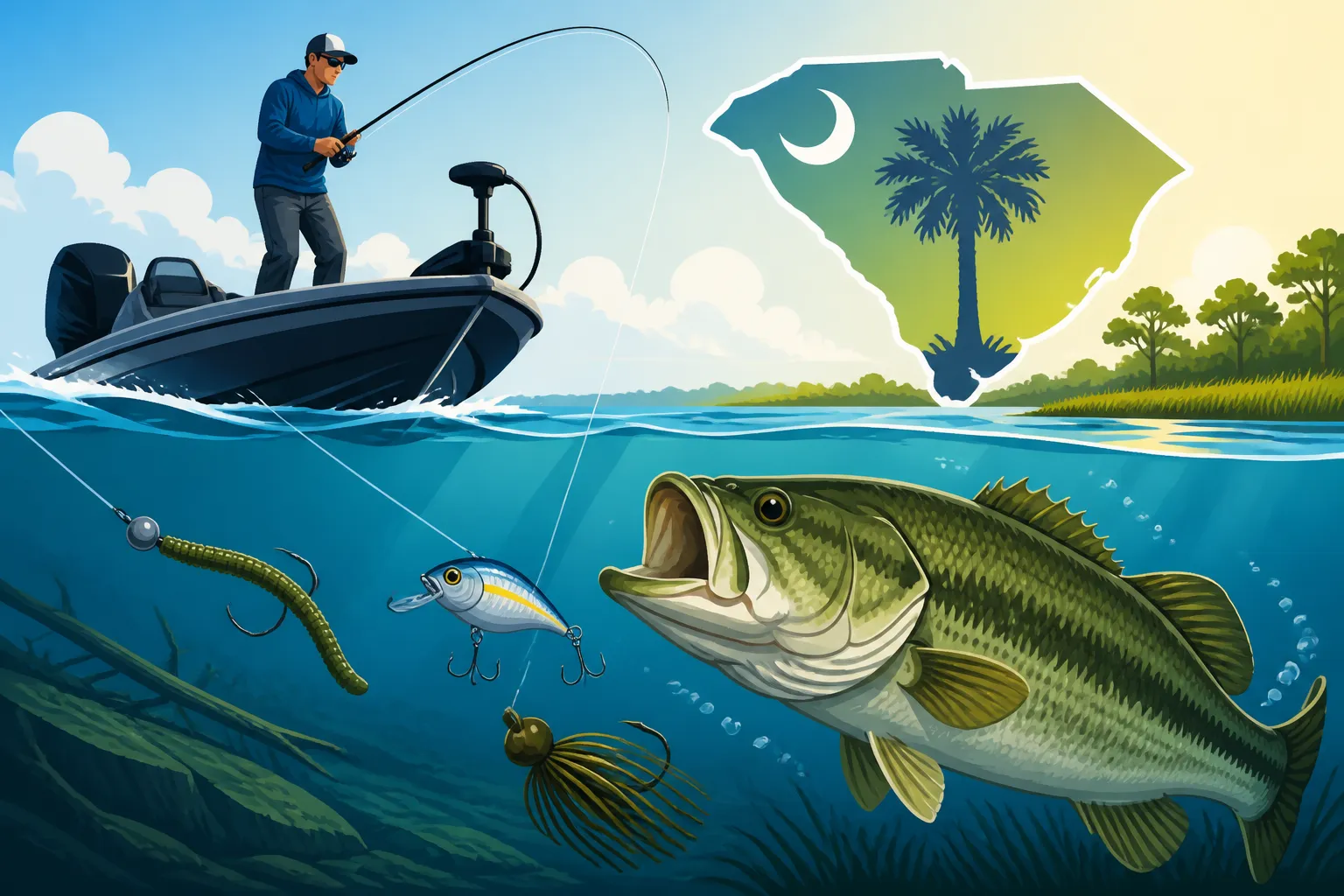
The lure selection for deep water bass fishing is incredibly diverse, each designed to tackle specific situations and depths. Having a good variety is crucial because what works one day might not the next.
| Lure Type | Target Depth Range | Primary Technique | Key Features & Tips |
|---|---|---|---|
| Deep-Diving Crankbaits | 12-25+ feet | Long casts, steady retrieve | Large lip, buoyant. Choose colors based on baitfish (shad, bluegill) or water clarity. Experiment with retrieve speed. Effective on Lake Murray for active bass on humps. |
| Football Jigs | 15-40+ feet | Dragging, hopping, slow crawling | Heavy head, weed guard, skirted. Mimics crawfish. Excellent for rocky bottoms, ledges, and brush piles. Pair with a bulky soft plastic trailer. |
| Dropshot Rigs | 10-50+ feet | Vertical presentation, finesse | Small hook, soft plastic bait, lead weight below. Extremely versatile for suspended fish or pinpointing structure. Great for pressured fish or cold water. Focus on clear water lakes like Keowee. |
| Carolina Rigs | 10-30+ feet | Dragging, slow retrieve, casting | Leader, swivel, bullet weight. Presents soft plastic bait slightly off the bottom. Excellent for covering ground, especially on flat, featureless deep areas or broad points. |
| Spoon/Blade Baits | 10-60+ feet | Jigging, vertical presentation | Metal construction, flashy. Mimics dying baitfish. Ideal for schooling fish or vertical presentations over deep humps and ledges. Can be fished aggressively or with subtle lifts and drops. |
| Swimbaits (Weighted) | 10-30+ feet | Slow retrieve, steady swimming action | Realistic baitfish imitation. Excellent for suspended bass or those cruising slightly above structure. Can be rigged with a jig head or internal weight. Brands like Keitech and Megabass make excellent deep-water swimbaits. |
| Heavy Texas Rigs | 15-40+ feet | Punching, dragging, flipping | Heavy bullet weight, worm hook, soft plastic (creature bait, large worm). Designed to penetrate dense cover like brush piles and thick hydrilla mats. Good for targeting specific structure when bass are holding tight. |
Having a variety of these lures, along with different weights and colors, will ensure you're prepared for whatever the deep water throws at you. Remember that even small details, like using the right hook on your Texas Rig, can make a significant difference.
Mastering Deep Water Bass Techniques
Fishing deep water from a boat isn't just about dropping a line down; it involves precise boat control, careful lure presentation, and an understanding of how bass react to different retrieves at various depths. Each technique has its nuances, and becoming proficient in a few will greatly increase your chances of success.
Vertical Jigging for Suspended Bass
Vertical jigging is an incredibly effective technique, especially when you've located schools of baitfish and bass suspended over deep water, or when bass are tightly grouped on a specific piece of structure like a sunken brush pile or a rock outcropping. This technique focuses on presenting a lure directly to the fish you've identified on your sonar.
The beauty of vertical jigging lies in its precision. Once you mark fish, you can use your trolling motor (preferably a GPS-enabled one with spot-lock, like a Minn Kota Ulterra or a Garmin Force) to hover directly over them. Lures typically used include heavy football jigs, blade baits (like a Silver Buddy or a Heddon Sonar), or vertical spoons (such as a War Eagle Spoon). The key is to drop your lure to the exact depth where the fish are holding, then work it with a series of lifts and drops, mimicking an injured or dying baitfish. A common retrieve involves lifting the rod sharply a foot or two, then letting the lure fall back on a semi-slack line, allowing it to flutter enticingly. Many bites will occur on the fall, so watching your line for any twitch or hesitation is critical. This approach is particularly effective in large, deep lakes like Santee Cooper, where bass frequently suspend over vast open water or deep river channels, chasing bait. For tips on specific jigging techniques, you might find our guide on Crappie Jigging Techniques for Beginners helpful, as some principles translate to bass.
Slow-Rolling Deep Diving Crankbaits
When bass are spread out over deep flats, points, or long ledges, and are actively feeding, a deep-diving crankbait can be an absolute dynamite choice. The goal here is to keep the lure in constant contact with the bottom or structure at its maximum running depth, grinding and deflecting off anything it encounters. This deflection triggers reaction strikes from bass that might not be aggressively chasing.
Select a crankbait that can reach or slightly exceed the depth you're targeting. For instance, if bass are at 18 feet, use a crankbait rated for 20-25 feet. Make long casts, allowing the crankbait to sink to its running depth as you retrieve. A steady, slow to medium retrieve is usually best, allowing the lure's bill to dig into the bottom. When you feel it hit a rock, stump, or shell bed, pause for a split second to let it float up slightly, then continue your retrieve. This "stop-and-go" or "deflection" action is often when bass will strike. This technique is fantastic for covering water quickly and finding active fish, especially during the post-spawn and early summer periods on reservoirs like Lake Hartwell or Lake Greenwood. Some anglers even prefer to get their deep diving crankbaits in bulk from a retailer like Amazon to ensure they have enough color and depth options.
Dropshotting and Carolina Rigging
These two techniques represent the finesse and versatility side of deep water bass fishing, respectively. They are indispensable for pressured fish, finicky eaters, or when you need to present a bait very precisely.
-
Dropshotting: The dropshot rig shines in clear water and when bass are suspended or tightly clustered around vertical structure like standing timber or bridge pilings. The unique setup, with the hook tied directly to the main line a foot or two above a weight, allows your soft plastic bait (often a small worm or minnow imitation) to hover enticingly at a specific depth, independent of the bottom. You can shake the rod tip to impart subtle action to the bait without moving the weight, keeping it in the strike zone longer. This is incredibly effective for targeting individual fish you see on your electronics or fishing a specific depth zone around cover. Many anglers find dropshotting particularly productive on clearer Upstate lakes like Lake Keowee, especially during colder months or after a cold front.
-
Carolina Rigging: The Carolina rig is your workhorse for covering large areas of deep water, especially over relatively clean bottom with scattered cover. It consists of a heavy weight (1/2 to 1 oz) threaded onto the main line, followed by a bead, a swivel, and then a leader (2-4 feet long) tied to a soft plastic bait. The weight drags along the bottom, creating commotion and stirring up sediment, while the buoyant bait trails behind, presenting a natural, unweighted action. This rig is fantastic for sweeping deep points, humps, and ledges. A slow, steady drag with occasional pauses is usually the most effective retrieve. The Carolina rig is a staple for targeting bass on broad, deep flats found in many South Carolina lakes, including parts of Lake Wylie or Lake Wateree, and can be especially effective when you're exploring for active schools.
Locating Deep Water Bass Structure in South Carolina Lakes
Finding deep water bass isn't just about dropping your lure in the deepest part of the lake. It's about understanding and identifying the underwater features that attract and hold fish. These structures act as highways, ambush points, and resting areas, providing everything a bass needs to survive and thrive. Your marine electronics are your best friend in this endeavor, but knowing what to look for is paramount.
Identifying Key Structural Elements
South Carolina's reservoirs are rich with diverse underwater structures that are irresistible to deep water bass. Each type of structure offers unique advantages for fish, and learning to identify them on your sonar is key to consistent success.
- Humps and Ridges: These are elevated areas on the lake bottom that rise significantly from the surrounding depth. A hump might be surrounded by 30 feet of water but top out at 15-20 feet, creating a prime ambush point for bass. Ridges are elongated versions, often connecting deeper and shallower areas, acting as travel corridors. Bass will often hold on the sides or tops of these humps and ridges, particularly near any isolated cover like a stump or a rock pile. On Lake Murray, for example, there are countless submerged humps that become striped bass and largemouth bass magnets in the summer.
- Ledges and Drop-offs: A ledge is a sharp, often dramatic change in depth. Bass love ledges because they offer quick access to different depths, bait concentrations, and current breaks. They can move up to feed on the shallower side and quickly retreat to deeper water for safety or comfort. Fishing parallel to a ledge, allowing your lure to "fall" off the drop-off, is a highly effective strategy. These are especially prevalent in river-run lakes where old creek channels carved steep banks before the lake was filled.
- Brush Piles and Standing Timber: These are obvious cover elements, but in deep water, they are even more critical. Submerged brush piles (natural or man-made) provide excellent ambush points and protection for bass. Standing timber, remnants of forests flooded when the lakes were formed, offers vertical cover that can hold bass at various depths. Your side imaging is invaluable for locating these hidden treasures. Once found, mark them as a waypoint on your GPS, and approach carefully, using dropshot or heavy Texas rigs to pick apart the cover. You can learn more about finding these productive spots in South Carolina's Best Bass Fishing Lakes.
- Rock Piles and Boulders: Rocky areas offer unique habitat, attracting crawfish and other invertebrates, which in turn attract bass. Rock piles also absorb and radiate heat differently than mud, providing thermal advantages. Football jigs and Carolina rigs excel in these areas, as they can be dragged over the rocks without excessive snagging, mimicking a crawfish scurrying along. These can be particularly good on clearer, rocky bottom lakes in the upstate.
- Roadbeds and Foundations: Often, when lakes are impounded, old roads, bridges, and building foundations are submerged. These linear structures or hard bottom areas create distinct underwater features that bass will relate to. A deep roadbed crossing a major creek channel can be a superhighway for bass, especially if it has old culverts or bridge pilings on it. Using your GPS mapping with high-definition contours can help identify these historical features.
Reading Your Electronics Effectively
Your fish finder is only as good as your ability to interpret its readings. Learning to read your sonar isn't just about seeing "fish arches"; it's about understanding the entire underwater landscape your screen is painting.
- Identifying the Thermocline: Pay close attention to your 2D sonar in summer. You'll often see a distinct, diffuse line or band on the screen where the water temperature changes rapidly. This is your thermocline. Bass will typically hold at or just above this line, where the oxygen and temperature are optimal. Baitfish will also congregate here.
- Distinguishing Fish from Structure: Sometimes, a tight school of baitfish or a dense brush pile can look similar to a solid mass on 2D sonar. Use your Down Imaging and Side Imaging to get a clearer picture. Individual fish arches will be distinct on 2D, while solid structure will appear more consistent. Side Imaging is excellent for seeing the shape and extent of brush piles or rocky bottom away from your boat.
- Understanding Bottom Hardness: Most modern sonars have settings that can indicate bottom hardness. A harder return (often displayed as a thicker or brighter line) usually indicates rock or gravel, while a softer return indicates mud or silt. Bass often prefer harder bottoms for spawning and feeding.
- Marking and Re-visiting Waypoints: When you find something interesting – a brush pile, a school of bait, or an active fish – mark a waypoint immediately. Don't assume you can find it again visually. Having precise waypoints allows you to fish productive spots more efficiently and helps you map out patterns. Over time, you'll build a personal library of productive deep water spots across your favorite South Carolina bass fishing lakes. Learning to use your electronics well is critical for How to Fish Deep Water From a Boat.
Seasonal Adjustments for Deep Water Bass Fishing
While deep water fishing might seem synonymous with summer, bass can be found in the depths throughout much of the year in South Carolina, though their exact location and behavior will shift with the seasons. Understanding these seasonal movements is crucial for staying on top of the bite.
Summer: The Deep Water Prime Time
Summer is undeniably the peak season for deep water bass fishing in South Carolina. As surface temperatures soar into the 80s and 90s, largemouth bass, especially the larger, more mature fish, retreat from the shallow flats and coves to seek refuge in the cooler, more stable waters of the thermocline. This migration typically begins in late spring, after the Largemouth Bass Spawning Season Explained, and continues through the hottest months.
During summer, bass will often relate to deep structure such as main lake points, offshore humps, deep ledges, and creek channel bends. They'll also orient themselves to deep standing timber or brush piles that offer both cover and access to the preferred temperature and oxygen zones. Baitfish, primarily threadfin shad and blueback herring, will also school up in these cooler depths, providing a readily available food source. Your best bet is to use your electronics to locate schools of bait and any nearby structure at the depth of the thermocline. Once you find them, vertical jigging, dropshotting, or slow-rolling deep-diving crankbaits are prime tactics. Early mornings and late evenings can sometimes see bass pushing shallower to feed briefly, but for the majority of the day, they will be deep. For specialized tips on this season, check out Lake Murray Summer Striped Bass Techniques in South Carolina, as some principles can apply to largemouth in the same deep zones.
Fall and Winter: Transitioning and Wintering Holes
As the weather cools in the fall, particularly after the first few significant cold fronts, the lake begins to "turn over." The surface water cools, becomes denser, and sinks, mixing with the deeper layers. This breakdown of stratification can temporarily scatter fish, making them harder to locate. However, once the turnover is complete and the lake stabilizes, bass will again establish deeper patterns, though often different from their summer haunts.
In early fall, bass will often follow baitfish as they move towards the backs of creeks or shallower flats, especially on cloudy days or during periods of stable weather. But when cold fronts push through, they'll retreat to deep channel swings, isolated humps, or creek junctions with vertical depth. As winter sets in, bass typically settle into their deepest wintering holes. These are often the deepest parts of creek channels, main lake channels, or significant drops. They become lethargic, conserving energy, and are less likely to chase fast-moving baits. Finesse techniques like dropshotting or slow-crawling a football jig become highly effective. You'll need to present baits slowly and directly to the fish. Look for vertical structure such as standing timber or deep brush that can hold fish off the bottom. Consider exploring how Lake Hartwell Spring and Fall Bass Fishing Patterns in South Carolina can inform your deep water strategies during these transition periods. Even in winter, a well-placed jig or spoon can entice a bite from a sluggish deep water bass.
Common Pitfalls and Pro Tips for Deep Water Bass
Even with the right gear and knowledge, deep water bass fishing can be challenging. Many anglers fall into common traps that hinder their success. Being aware of these pitfalls and adopting some pro strategies can significantly improve your catch rate.
Overlooking Subtle Signs and Details
One of the biggest mistakes anglers make is not paying close enough attention to the subtle clues the lake provides. In deep water, these clues are often less obvious than in the shallows.
- Ignoring Baitfish: Many anglers focus solely on finding bass arches on their sonar and overlook the presence of baitfish. Bass are predators; they go where the food is. If you find dense schools of shad or herring in the thermocline, especially near structure, bass are almost certainly nearby. Sometimes, the bass will be right underneath the bait, sometimes on the fringes. Don't be afraid to cast or drop into these bait schools. You might even find that some of the Best Bait for Largemouth Bass in South Carolina Lakes are indeed these very baitfish.
- Speed Kills (Sometimes): In deep water, particularly when bass are less active (e.g., in colder water or after a cold front), a faster retrieve often results in no bites. Many anglers retrieve their deep-diving crankbaits too quickly or work their jigs too aggressively. Slow down! Let your lure spend more time in the strike zone. Sometimes, the most subtle twitch or barely-there crawl is what it takes to provoke a strike from a sluggish bass.
- Lack of Persistence: Deep water bass fishing often requires a lot of searching and patience. You might spend hours idling around, scanning with your electronics, before you find a productive spot. The temptation to move back to the shallows or switch techniques too quickly can be strong. Once you find a productive area, commit to thoroughly working it. Make multiple passes from different angles. Change lure colors or sizes. A little persistence can turn a slow day into a memorable one. Remember that targeting a Chasing a Record Largemouth Bass in South Carolina often requires such dedication.
- Poor Knot Tying: When you're fishing with lighter lines and presenting baits deep, a weak knot is a recipe for disaster. One missed fish or lost lure due to a knot failure can ruin your day. Practice reliable knots like the Palomar knot or the improved clinch knot, and retie them frequently, especially after catching a fish or getting snagged. The small amount of time spent retying is well worth the security.
Boat Control and Positioning: The Silent Edge
Effective boat control is perhaps the single most critical factor for consistent success in deep water. It's not just about steering; it's about precision, stealth, and maintaining ideal lure presentation.
- The Power of the Trolling Motor: Your electric trolling motor is your most important tool for deep water boat control. Modern GPS-enabled trolling motors with "spot-lock" or "anchor mode" features are absolute game-changers. They allow you to hold your boat in a precise position over a marked waypoint or piece of structure, even in wind or current, without having to drop an anchor. This frees you up to focus on fishing and makes repetitive casts to a specific target much easier. For example, if you mark a small brush pile in 25 feet of water, you can spot-lock directly over it and dropshot or jig it meticulously. Our guide on Boat Positioning Techniques for Bass Fishing delves deeper into these strategies.
- Drifting and Fan Casting: When bass are scattered over a broad area, or when you're simply trying to locate them, a controlled drift can be highly effective. Use your trolling motor to guide your boat along a contour line, a long point, or across a deep flat. As you drift, fan cast a deep-diving crankbait, Carolina rig, or swimbait, covering as much water as possible. This allows you to present your lure to different fish holding at various depths and positions along the drift. Pay attention to where the bites occur so you can refine your drift path.
- Approaching from Upwind/Upcurrent: Always try to approach your target deep water structure from upwind or upcurrent. This allows you to make a quiet, controlled approach using your trolling motor, drifting silently over the area. Coming in with the wind or current at your back makes boat control harder and can cause you to overshoot your target or disturb the fish. Stealth is key in deep water; boat noise travels surprisingly well underwater and can spook fish.
- Understanding Your Casting Angle: Your casting angle relative to the structure matters. If you're fishing a deep ledge, for example, casting parallel to it will keep your lure in the strike zone longer than casting perpendicular to it. Experiment with different angles. Sometimes, a subtle change in how your lure approaches a piece of cover can make all the difference.
By mastering these techniques and paying close attention to the details, you'll be well on your way to unlocking the secrets of South Carolina's deep water bass fishing, no matter the season or the lake.
Disclaimer
Please note that fishing regulations, including bag limits, size limits, and open seasons, can change. It is the angler's responsibility to check the latest regulations issued by the South Carolina Department of Natural Resources (SCDNR) before fishing. This guide is for informational purposes only and should not be considered a substitute for official regulations.