Striped Bass Depth Patterns at South Carolina’s Lake Murray in Summer
One of the biggest head-scratchers for anglers hitting South Carolina's Lake Murray in the scorching summer months is figuring out where those elusive striped bass have disappeared to. You cast your favorite topwater plug in the mornings, work the banks, and come up empty, leaving you wondering if the fish just vanished. But trust me, they haven't; they've simply shifted their patterns, heading for deeper, cooler, more oxygenated waters. This guide is all about demystifying those summer striped bass depth patterns on Lake Murray, helping you understand where they hide and how to tempt them to bite.
Understanding the Summer Struggle for Lake Murray Stripers
Lake Murray is a magnificent fishery, but its sheer size and depth can make finding fish a real challenge, especially when the mercury climbs. Striped bass are cold-water fish at heart, even the landlocked varieties we have here. When the surface temperatures push into the 80s and beyond, they have to seek refuge. It's not just about comfort; it's a matter of survival.
Why Striped Bass Go Deep in Summer
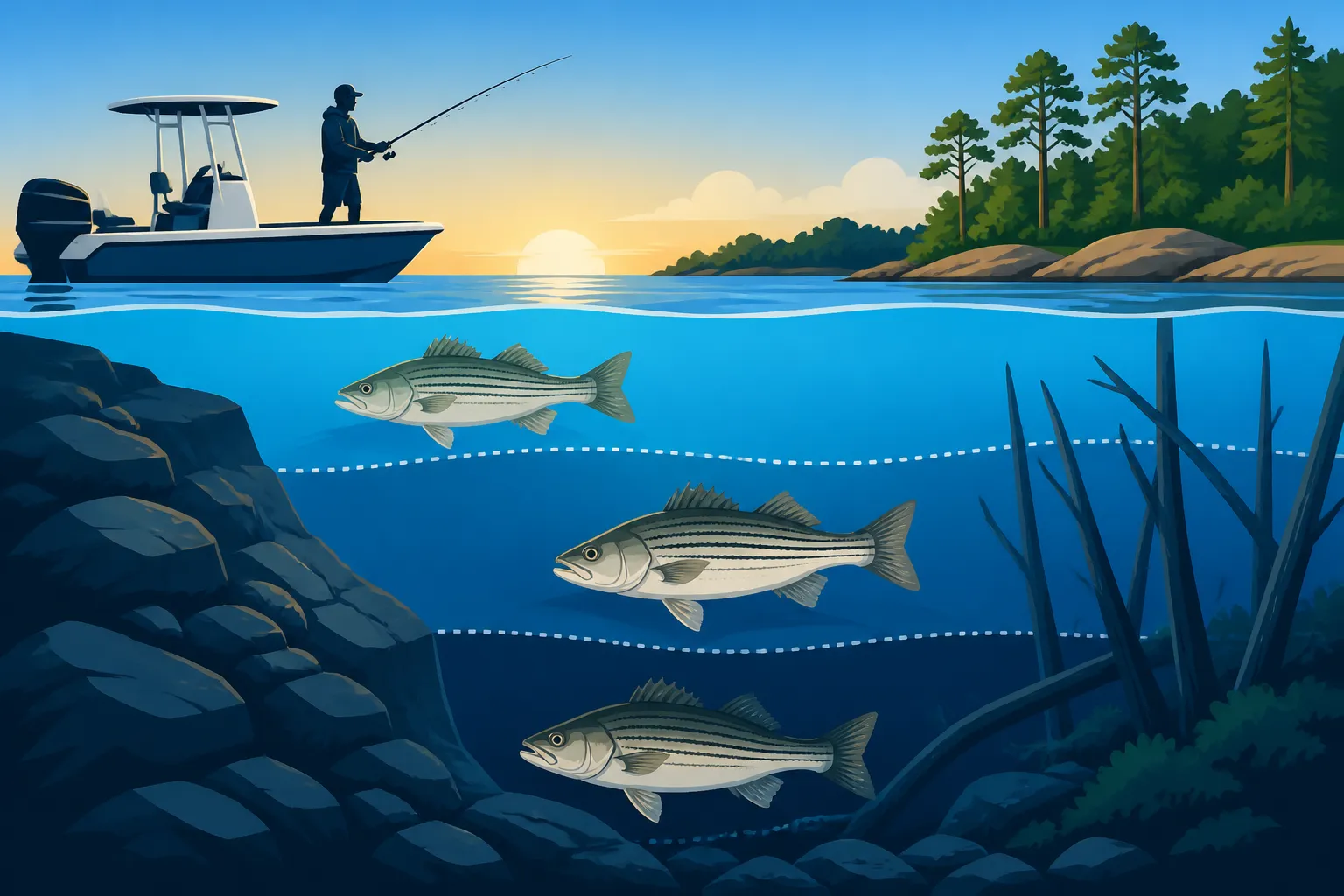
The primary reason striped bass head for the depths in summer is something called the thermocline. Imagine a lake like a layered cake: the top layer is warm, oxygen-rich, and bathed in sunlight. The bottom layer is cold, dark, and often low on oxygen, especially in deeper, nutrient-rich lakes like Murray. In between these two is the thermocline—a distinct band where the water temperature drops rapidly.
For stripers, this thermocline is like their air-conditioned sanctuary. It provides the cooler temperatures they need to thrive. However, it's a delicate balance. They also need enough dissolved oxygen to breathe. So, while they seek cool water, they won't go too deep if the oxygen levels become critical. Often, the best striper action happens right at or just above the thermocline, in what's known as the "comfort zone." This zone might be anywhere from 20 to 60 feet deep, depending on the lake's specific conditions and the time of summer.
Another crucial factor is baitfish movement. Where the bait goes, the stripers follow. During summer, many of Lake Murray's primary bait species, like blueback herring and gizzard shad, also gravitate towards cooler, deeper water, often suspending near the thermocline or congregating around deep structures. If you can find the schools of bait, you’re usually halfway to finding the stripers themselves. This explains why Lake Murray Stripers Move Deeper as Water Warms; it's a fundamental biological response.
The Impact of Water Temperature on Striper Behavior
Water temperature dictates nearly everything about a striper's metabolism and activity levels. In summer, as surface waters heat up, stripers become less active during the day, conserving energy in their cooler deep-water hideouts. Their feeding windows often shrink, becoming more pronounced during dawn, dusk, and even at night when surface temperatures are at their lowest.
Understanding the specific temperature range that stripers prefer is key. Generally, they are most comfortable and active in water temperatures ranging from the mid-50s to the low 70s Fahrenheit. Anything consistently above that, and they start to feel the stress, prompting their move to depth. Monitoring lake temperatures with a good thermometer or your fish finder can give you a significant advantage in pinpointing their comfort zone. If you're out on the water and seeing surface temps in the high 80s, you know for sure that the fish are hunkered down, likely in the 30-50 foot range, seeking that sweet spot of cool water and ample oxygen. This is a critical piece of the puzzle when it comes to Lake Murray Summer Striped Bass Techniques in South Carolina.
Locating Deepwater Stripers: Tools and Techniques
Finding deepwater stripers in Lake Murray during the summer isn't about luck; it's about employing the right tools and knowing how to interpret what they're telling you. Your electronics are your best friends in this pursuit, and a solid understanding of sonar is non-negotiable.
Essential Electronics for Depth Finding
A high-quality fish finder is absolutely indispensable for summer striper fishing on Lake Murray. You're looking for units with good sonar capabilities, including traditional 2D sonar, as well as Down Imaging and Side Imaging if your budget allows. Brands like Humminbird, Lowrance, and Garmin offer excellent options across various price points. You can find a vast array of these technologies and accessories on Amazon, often with competitive pricing and detailed reviews.
- 2D Sonar: This is your bread and butter. It shows you the water column beneath your boat, revealing depth, bottom contour, and fish arches. Learn to adjust your sensitivity to cut through clutter but still pick up bait balls and individual fish.
- Down Imaging: Provides a picture-like view directly below your boat, making it easier to identify structure, submerged trees, and tightly packed bait schools. It helps differentiate between a cluster of bait and an actual fish.
- Side Imaging (or SideScan): This is a game-changer for covering vast areas. It allows you to "see" out to the sides of your boat, scanning large swaths of water for submerged structures, creek channels, and suspended schools of bait or stripers that you might otherwise troll right over.
Beyond the sonar, a good GPS unit, often integrated into modern fish finders, is crucial for marking productive spots, tracking your troll paths, and navigating back to those hot zones. Having detailed mapping with contour lines helps immensely in identifying potential deep-water structures.
Interpreting Your Sonar
This is where experience really comes into play. Learning to read your sonar screen effectively takes time, but here's what you should be looking for specifically for summer stripers:
- Thermocline: On your 2D sonar, the thermocline often appears as a distinct, hazy line or band across the screen. Below this line, you'll notice fewer or no fish arches, indicating low oxygen levels. The stripers will be found at or just above this line.
- Bait Balls: These show up as dense clouds of dots or marks. Baitfish are often the first sign you're in a productive area. Small, tight balls indicate bait being actively pursued; looser, more spread-out bait might mean they're relaxed, or the predators haven't moved in yet.
- Fish Arches: Stripers will show up as strong, distinct arches, often larger than individual baitfish. Look for them suspended near or within the bait balls, or holding tight to deep structure. Multiple large arches together are a tell-tale sign of a striper school.
- Bottom Contour and Structure: Pay close attention to deep creek channels, submerged humps, points, and old roadbeds. These are common ambush points and holding areas for Striped Bass Fishing on Lake Murray, South Carolina, especially when they are looking for cover and a place to rest.
Advanced Depth-Finding Strategies
Beyond just scanning, there are more proactive ways to use your electronics to locate summer stripers.
- Drifting: If you're fishing live bait, especially when the wind is favorable, a slow drift across known deep structures like the humps near Dreher Island can be incredibly effective. Let your electronics guide you, watching for bait and fish as you move. When you find them, mark the spot and repeat the drift.
- Trolling Patterns: When trolling, don't just go in straight lines. Experiment with S-curves and zig-zags. This varies the depth of your lures and covers more water, helping you identify where the fish are holding vertically in the water column and horizontally across the bottom.
- Mapping for Structure: Before you even launch, spend time studying detailed lake maps (either on your unit or physical charts). Look for abrupt depth changes, deep points that drop off quickly, and submerged islands or humps. These are prime targets for deepwater stripers. Services like Navionics or C-MAP offer incredibly detailed contours, helping you pinpoint potential hotspots. Using these maps in conjunction with your sonar once on the water will help you target the most promising areas.
Effective Fishing Techniques for Deepwater Stripers
Once you've located those deep-dwelling Lake Murray stripers, the next challenge is getting them to bite. Different techniques excel in different situations, but all involve presenting your offering right in their strike zone.
Downlining Live Bait
This is arguably the most consistent and effective method for summer stripers on Lake Murray. Stripers are opportunists, and a struggling live baitfish presented right in front of them is often irresistible.
- Bait Selection: Your best bet is live blueback herring or gizzard shad. These are natural forage for Lake Murray stripers. You'll need a good bait tank to keep them lively throughout the day.
- Rigging: Use a simple Carolina-style rig. Attach a barrel swivel to your main line, then a 1 to 2-ounce egg sinker (adjust weight based on depth and current), followed by another barrel swivel. To this, tie a 2 to 4-foot fluorocarbon leader (15-25 lb test is usually good) to a 4/0 to 6/0 circle hook. Circle hooks are fantastic for preserving fish health if you plan to release them, as they tend to hook in the corner of the mouth. You can find these quality hooks and other terminal tackle on Amazon for convenience.
- Presentation: Drop your live bait directly to the depth where you're seeing stripers on your sonar. Watch your rod tip or use a bait clicker on your reel. When a striper hits, resist the urge to set the hook immediately. Let the fish take the bait, and the circle hook will do its job as the line tightens. Remember to rig your bait through the nose or back, avoiding the spine, to keep it active. This technique is especially effective when Anchoring the Submerged Humps Near Dreher Island for Stripers.
Trolling Deep-Diving Lures
Trolling allows you to cover a lot of water and can be highly effective when stripers are spread out or actively chasing bait.
- Lure Selection: Deep-diving crankbaits are excellent choices. Look for models that can reach 20-30 feet or more, such as those from Rapala, Bandit, or Bomber. Colors mimicking baitfish like silver, blue, or shad patterns are usually winners. Umbrella rigs are another powerful option, allowing you to present multiple baits (either bucktails, swimbaits, or real baitfish) at once. You can browse a wide selection of these lures, including specific models often recommended by local guides, on Amazon.
- Depth Control: Achieving the right depth is crucial. You can control this with line diameter (thinner lines dive deeper), trolling speed, and the size of your crankbait's lip. Downriggers or planer boards can also be used to get lures to specific depths or away from the boat, especially if you're targeting fish deeper than your lures naturally run.
- Speed: Experiment with trolling speeds from 1.5 to 3.5 mph. Sometimes a subtle change in speed is all it takes to trigger a strike. Pay attention to your rod tips to ensure your lures are running true and not fouled. This is key to finding the Best Lures for Lake Murray Striped Bass in South Carolina Summer.
Vertical Jigging and Spooning
When stripers are tightly schooled or suspended directly beneath the boat, vertical jigging or spooning can be incredibly productive.
- Technique: Drop a heavy spoon or jig (like a Hopkins Shorty, Kastmaster, or a large bucktail jig) directly down to the depth of the fish. Let it hit the bottom or go just below the fish, then retrieve it with sharp, upward jerks, allowing it to flutter back down on a semi-slack line. Most strikes occur on the fall.
- Lure Weight: Use enough weight to get your lure down quickly to the fish's depth. In deeper water or current, this might mean a 1-ounce spoon or heavier.
- Rod and Reel: A medium-heavy spinning or baitcasting rod with a fast action tip works well, paired with a reel spooled with braided line for sensitivity and strength. This allows for quick, sharp jigging motions and immediate feedback on strikes. This method is an excellent way to How to Fish Deep Water From a Boat and target those specific schools you see on your sonar.
Prime Locations on Lake Murray for Summer Stripers
Lake Murray is vast, so having a few key areas in mind can save you a lot of time and fuel. While stripers can be found almost anywhere there's cool, oxygenated water and bait, certain structural elements consistently hold them during the warmer months.
Targeting Submerged Humps and Points
These are perennial favorites for summer stripers on Lake Murray. Submerged humps rise up from the lake bottom, creating breaks in the contour and ambush points for predatory fish. Points that extend far out into the lake, especially those with steep drop-offs into deep water, serve a similar purpose.
- Locating Them: Use your detailed lake maps and side imaging sonar to identify humps, ledges, and points that top out in 20-40 feet of water and then drop into much deeper water. These underwater structures act like magnets for baitfish and, consequently, stripers.
- Fishing Strategy: Position your boat over or around these structures. Downline live bait around the edges of the humps or troll deep-diving lures over and around them. Watch your sonar constantly; fish often relate to a specific side or depth on a hump based on current or bait presence. Focusing on these spots can really pay off when looking for the best spots on the lake for Striped Bass Fishing on Lake Murray, South Carolina.
Fishing the Dam and Deep Channels
The area around the Lake Murray Dam is known for its deep water and can hold large schools of stripers, especially during periods of power generation when current is created. Similarly, the main river channels that snake through the lake provide natural highways and deep holding areas for fish.
- Dam Area: Exercise caution around the dam due to potential strong currents. Fish the edges of the channel leading to the dam. Trolling deep-diving lures or downlining heavy live bait can be effective here. Remember that the water can be extremely deep, so finding that thermocline is even more critical.
- Main Channels: Follow the old riverbed contours through the lake. Stripers will often suspend in these channels, especially if there are baitfish congregating. Side imaging is excellent here for spotting schools off to the side of your boat as you motor along. When you mark fish, you can either drop live bait or make trolling passes. The Best Time of Year to Catch Striped Bass on South Carolina's Rivers is often associated with these migratory patterns and deep-water haunts.
Locating Baitfish Schools
Ultimately, finding baitfish is the absolute key to consistently finding summer stripers. Stripers are constantly on the hunt for food, and where there's a buffet, they'll be there.
- Sonar is Your Eye: Your fish finder should be set to detect bait. Look for those dense clouds on your screen. Don't be afraid to spend time idling around until you mark significant bait.
- Bird Activity: Keep an eye on the sky! Gulls and other seabirds diving or congregating often indicate baitfish being pushed to the surface by feeding predators, including stripers. While this is more common in fall and spring, it can still happen on summer mornings or evenings.
- Surface Activity: Although less common in the heat of summer midday, early morning or late evening might reveal stripers busting the surface, chasing bait. If you see this, move quickly and cast topwater lures or fast-retrieved swimbaits into the frenzy.
| Technique | Ideal Depth Range | Best Bait/Lure | Key Advantages | Considerations |
|---|---|---|---|---|
| Downlining Live Bait | 20-60 feet | Blueback Herring, Gizzard Shad | Highly effective for finicky fish, natural presentation | Requires live bait, slower coverage |
| Trolling Deep-Diving | 15-40 feet | Large Crankbaits, Umbrella Rigs, Swimbaits | Covers large areas, triggers reaction strikes | Requires specific lure depths, multiple rods can tangle |
| Vertical Jigging/Spoon | 20-70 feet | Heavy Spoons, Bucktail Jigs, Blade Baits | Excellent for schooled fish, precise depth control | Can be tiring, requires accurate boat positioning |
| Planer Board Trolling | Variable (Surface to 30ft) | Smaller Crankbaits, Swimbaits, Live Bait | Spreads baits out, covers vast shallow zones | Can be cumbersome, requires specific setup |
Remember, consistency and patience are your best allies. The fish don't always cooperate, but by understanding their summer patterns and using your tools effectively, you'll dramatically increase your chances of hooking into those powerful Lake Murray stripers.
Disclaimer
The information provided in this guide is for general informational purposes only and is not intended as legal or professional advice. Fishing regulations, conditions, and fish behavior can change rapidly. Always consult the latest regulations from the South Carolina Department of Natural Resources (SCDNR) before fishing. Fishing involves inherent risks, and adherence to safety guidelines is crucial.