How to Identify a Largemouth Bass
There’s nothing quite like the thrill of feeling that tug on your line, reeling in a beautiful bass, and then wondering, "Okay, what kind of bass is this, exactly?" It’s a common frustration for anglers across South Carolina, especially when you're trying to abide by specific regulations for different species or simply want to brag accurately to your buddies. This guide is here to cut through the confusion and help you confidently identify a Largemouth Bass, one of the most sought-after freshwater game fish in our Palmetto State waters.
The Defining Characteristics of a Largemouth Bass
Let's dive into what truly sets the Largemouth apart. These fish are iconic for a reason, and once you know what to look for, you'll start spotting them almost instantly, whether you're fishing the expansive Santee Cooper Lakes or a quiet farm pond. Their physical traits are quite distinct when you know where to focus your attention.
Overall Body Shape and Size
When you first land a Largemouth Bass, you'll often notice its robust, almost football-like shape, especially if it's a mature specimen. They tend to have a deep body, giving them a thick, powerful appearance. This isn't a slender fish; it's built for power and explosive strikes. Younger Largemouths might appear a bit more streamlined, but as they grow, they fill out, becoming stockier and more formidable. This broad profile is a key indicator, differentiating them from some of their more torpedo-shaped cousins.
Their size can vary wildly depending on the body of water and food availability. In a nutrient-rich lake like Lake Murray, you might encounter Largemouths that push several pounds, while in a smaller, less productive pond, they might remain on the smaller side. Regardless of the actual weight, the general impression is one of solid, muscular mass. It’s this broadness, from top to bottom, that often gives anglers their first hint that they’ve hooked a true Largemouth. They truly embody the "king of the freshwater" title with their impressive stature.
Mouth and Jaw Structure: The Most Reliable Clue
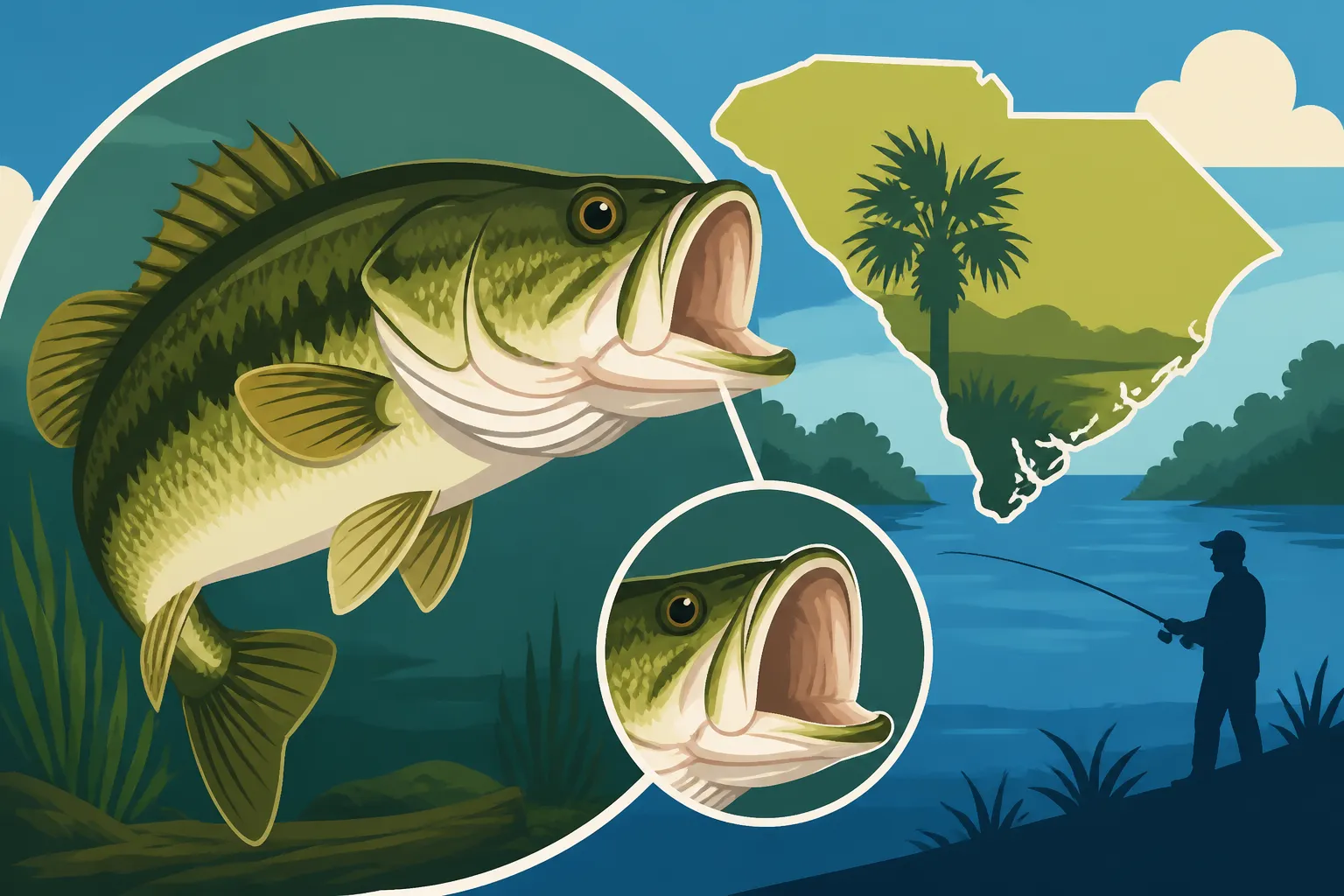
This is, without a doubt, the single most critical feature for identifying a Largemouth Bass, and it's even in their name! Many an angler has held up a fish, puzzled, only to have a seasoned veteran point directly to the mouth. The key here is the relationship between the corner of the jaw (the maxilla) and the eye. On a Largemouth, when you close its mouth, the hinge of the jaw extends noticeably past the rear edge of the eye.
To check this, gently hold the fish and carefully close its mouth. Run your finger from the corner of its jaw towards its eye. If your finger crosses the imaginary line of the back of the eye, you're almost certainly holding a Largemouth Bass. This oversized maw allows them to gulp down larger prey items, from baitfish and crawfish to frogs and even small birds or rodents that happen to fall into the water. It’s a predatory adaptation that defines them and makes them such aggressive, exciting targets for anglers. Don't be afraid to get a little hands-on (carefully, of course!) to confirm this crucial detail, as it will clear up most identification dilemmas right away.
Lateral Line and Coloration Patterns
Beyond the jaw, a Largemouth Bass's appearance offers several other clues, particularly in its lateral line and the shades it displays. These features, while sometimes varying, provide consistent patterns that help with identification.
The Distinctive Lateral Line
The lateral line on a Largemouth Bass is usually quite prominent and often forms a rather jagged or broken horizontal stripe along the middle of its body, from the gill plate to the tail. This line is typically dark, ranging from a deep olive green to almost black, and it stands out against the lighter background of the fish's flanks. It's not always a perfectly straight, unbroken line; sometimes it appears as a series of dark blotches that merge to form a stripe.
This lateral line is more than just a decorative marking; it's a sensory organ that helps the fish detect vibrations and pressure changes in the water. For us anglers, it's a fantastic visual marker. While some other bass species have lateral lines, the Largemouth's often has a more pronounced, "blotchy" or "splotchy" appearance, especially in younger fish, that coalesces into that distinct stripe. Keep in mind that coloration can change rapidly based on the fish's environment – a bass from murky water might appear paler, while one from clear, grassy shallows will likely have very vibrant, dark markings. Nevertheless, that general pattern of a dark, often irregular, horizontal stripe is a strong indicator.
Common Coloration and Belly Hues
The overall coloration of a Largemouth Bass typically ranges from a dark green on its back, fading to lighter green or olive tones on its sides. This green coloration provides excellent camouflage in the vegetated waters they often inhabit, blending seamlessly with lily pads, submerged grass, and shady banks. The belly, in contrast, is usually a creamy white or pale yellow, offering a stark contrast to their darker sides and back. This countershading helps them avoid detection from both above and below.
Sometimes, especially in very clear water or during certain times of the year, you might notice hints of gold or bronze on their flanks. The dark lateral stripe mentioned earlier is almost always present, though its intensity can vary. If you catch a Largemouth from a muddy river, like portions of the Edisto River, its colors might be duller and more muted, almost a grey-green. However, pull one from the pristine, clear waters of Lake Keowee, and it might practically glow with vibrant greens and golds. Always look for the combination of the dark green back, lighter sides with the distinct lateral line, and that creamy white belly. South Carolina Fish Species: A Complete Guide to What's in the Water provides an even broader look at the diversity you can find.
Dorsal Fin Distinction and Scale Characteristics
Another key area to examine when identifying a Largemouth Bass is its fins, particularly the dorsal fin. These aren't just for swimming; they hold critical clues for identification.
The Separated Dorsal Fins
One of the most defining characteristics of a Largemouth Bass, often overlooked by beginners, is its dorsal fin structure. Unlike some other bass species where the spiny and soft-rayed dorsal fins are clearly connected, the Largemouth Bass has two distinct dorsal fins that are almost, if not entirely, separated. Imagine drawing a line from the lowest point of the dip between the two fins down to the back of the fish's body. On a Largemouth, this dip is very pronounced, making it look like two separate fins.
Sometimes there might be a very low membrane connecting them, but it’s so slight that it often appears as a clear break. This separation is a critical anatomical difference that helps differentiate them from Spotted Bass or Smallmouth Bass, where the dorsal fins are typically more obviously connected and form a continuous, albeit notched, structure. When you're holding the fish, gently run your finger along the top of its back; you'll distinctly feel the separation between the sharp, spiny front fin and the softer, more flexible rear fin. This is a very reliable feature to observe.
Scale Patterns and Texture
While not as immediately obvious as the mouth or dorsal fin, the scales of a Largemouth Bass also offer some minor identification clues. They have cycloid scales, which are generally smooth to the touch, especially compared to some other fish. The scales are relatively large and uniform over most of their body, becoming smaller on the head. You won't typically see any rough, ctenoid (comb-like) edges that are more common on fish like Crappie.
Another subtle feature, which ties into their coloration, is that the scales on the lateral line and surrounding areas often appear somewhat darker or more pronounced, helping to emphasize that distinctive horizontal stripe. The texture and pattern of their scales contribute to their sleek, hydrodynamic form, allowing them to move efficiently through the water, whether darting from cover to ambush prey or putting up a powerful fight on the end of your line. A good, waterproof fish identification chart, easily found on Amazon, can often highlight these subtle scale patterns in detailed drawings, helping you compare your catch.
Habitat and Behavior as Identification Aids
Sometimes, where and how a fish behaves can give you a strong hint about its identity, even before you get a close look. Largemouth Bass have preferred habitats and characteristic behaviors that set them apart.
Preferred Freshwater Environments
Largemouth Bass are masters of freshwater, preferring slow-moving or still waters with abundant cover. Think about the big, sprawling reservoirs like Lake Murray or the Santee Cooper Lakes, or even smaller, quiet ponds and oxbow lakes along rivers like the Congaree. They absolutely thrive in environments with plenty of submerged vegetation, fallen trees, brush piles, docks, and lily pads. These structures provide excellent ambush points from which they can launch surprise attacks on unsuspecting prey.
They are often found in warmer, shallower waters, especially during the spring and fall when they're actively feeding or spawning. During the hot South Carolina summers, they might retreat to deeper, cooler areas, but they’ll still relate to structure. If you’re pulling fish consistently from thick cover, especially in water that isn’t too swift, there’s a very high chance you’re dealing with Largemouth Bass. Best Fishing Spots in South Carolina often highlights locations teeming with the kind of cover Largemouths love.
Aggressive Feeding and Ambush Tactics
One of the most exciting aspects of Largemouth Bass fishing is their aggressive nature. They are apex predators in their freshwater habitats, known for their powerful strikes and fierce fights. They don't typically "graze" or slowly pick at food; they ambush. They'll lurk silently in the shadows of a lily pad or a submerged log, waiting for a baitfish, frog, or even a topwater lure to pass by, then explode with incredible speed and force. This aggressive behavior is a hallmark of the species.
Their diet is varied, including smaller fish, crawfish, frogs, and even small waterfowl. This diverse menu is another reason for their large mouth – it’s perfectly adapted for engulfing substantial meals. If you’re using lures that mimic these prey items, like a plastic worm, a spinnerbait, or a topwater frog, and getting explosive strikes near cover, you're almost certainly targeting Largemouth Bass. Understanding their predatory habits helps in identifying them not just by sight, but by the very way they interact with your bait. Bass Fishing Techniques for Spring Pre-Spawn and Post-Spawn Bass Patterns on South Carolina's Santee Cooper go into more detail about their seasonal behaviors.
Distinguishing Largemouth Bass from Similar Species
This is where the rubber meets the road for many South Carolina anglers. Our waters are home to several bass species, and sometimes telling them apart can feel like a pop quiz. Let's break down the key differences to help you avoid misidentification, especially when it comes to the trickiest lookalikes.
Largemouth vs. Spotted Bass
The Spotted Bass (Micropterus punctulatus) is probably the most common source of confusion with the Largemouth, especially in waters where both species coexist, like some of our larger reservoirs. They share similar body shapes and green coloration, but there are distinct differences:
- Jaw Line: This is your primary indicator. While the Largemouth's jaw extends past the eye, the Spotted Bass's jaw typically aligns with the middle of the eye or just slightly behind it. It's noticeably shorter.
- Dorsal Fins: Remember how the Largemouth has those distinctly separated dorsal fins? The Spotted Bass's dorsal fins are usually more clearly connected, forming a continuous, albeit deeply notched, structure.
- Lateral Line & Spots: The Largemouth has that horizontal stripe, sometimes blotchy. The Spotted Bass also has a lateral line, but it’s often punctuated by a series of distinct dark spots below the lateral line, arranged in neat rows. These spots, often feeling like rough scales when you run your hand against them, are a key giveaway that you have a Spotted Bass. That's why they call them "spotted"! Spotted Bass Identification and Where to Find Them in South Carolina gives a full breakdown.
- Tongue Patch: This is a very reliable, though less common to check, feature. Many Spotted Bass have a small patch of teeth on their tongue, which a Largemouth Bass almost never has. Gently open the fish's mouth and feel its tongue – if it feels rough, it's likely a Spotted Bass.
When you're out on the water, having a flexible, waterproof fish identification card (many good options available on Amazon) can be a lifesaver for these quick comparisons.
Largemouth vs. Smallmouth Bass
Smallmouth Bass (Micropterus dolomieu) are less common across the general South Carolina landscape, primarily found in the cooler, clearer, rocky waters of the Upstate rivers and reservoirs, particularly along the state's mountainous borders. Still, it's good to know the differences:
- Coloration: Smallmouths are typically browner or bronze-colored, often with vertical bars or stripes along their sides, rather than the distinct horizontal stripe of the Largemouth. They truly earn the nickname "bronze back."
- Body Shape: Smallmouths tend to be more torpedo-shaped and streamlined than the deeper-bodied Largemouth. They are built for current.
- Jaw Line: Just like the Spotted Bass, the Smallmouth's jaw does not extend past the rear edge of the eye. It's much shorter and more compact than a Largemouth's.
- Dorsal Fins: Similar to the Spotted Bass, their dorsal fins are usually more connected, forming a continuous structure.
- Eye Color: Smallmouths often have striking red eyes, which is a rare trait in Largemouths.
If you’re fishing a swift, rocky mountain stream in the very northwest corner of the state, and you catch a bronze-colored fish with red eyes and vertical bars, you've likely caught a beautiful Smallmouth. But in the vast majority of South Carolina waters, a Largemouth is far more probable. For more on this, check out Smallmouth Bass Fishing in South Carolina's Upstate Rivers.
Largemouth vs. Redeye Bass
The Redeye Bass (Micropterus coosae), also known as Coosa Bass, is another species primarily found in the clear, rocky streams of the extreme Upstate, particularly in the Savannah River drainage. They are beautiful fish but often confused with smaller Largemouths.
- Coloration: Redeye Bass typically have a dark olive green back with lighter sides, but they often have prominent black blotches or vertical bars, especially on their upper flanks, rather than a solid lateral stripe. The most striking feature, as their name implies, is often a reddish hue in their eyes.
- Jaw Line: Like the Smallmouth and Spotted Bass, the Redeye Bass has a much shorter jaw that does not extend beyond the rear margin of the eye. This is a consistent differentiator from the Largemouth.
- Fins: The Redeye Bass often has distinctive white or orange margins on its tail and anal fins, which is rarely seen on a Largemouth.
- Size: Redeye Bass are generally much smaller than Largemouth Bass, typically topping out at only a few pounds. A true trophy Redeye is a rare catch, while a five-pound Largemouth is a common goal.
Given their limited distribution in South Carolina, if you’re fishing in a lowland lake or river, you’re highly unlikely to encounter a Redeye Bass. But for those adventurous enough to explore the headwaters, knowing these subtle differences can make all the difference. Redeye Bass vs Largemouth Bass: How to Tell Them Apart offers a deeper comparison.
Here’s a quick reference table to help visualize these key differences:
| Feature | Largemouth Bass | Spotted Bass | Smallmouth Bass | Redeye Bass |
|---|---|---|---|---|
| Jaw Extension | Extends past the rear edge of the eye | Ends at or before the middle of the eye | Ends at or before the middle of the eye | Ends at or before the middle of the eye |
| Dorsal Fins | Clearly separated, deep notch | Connected, deeply notched | Connected, deeply notched | Connected, deeply notched |
| Lateral Line | Dark, distinct horizontal stripe, often broken | Horizontal stripe with distinct spots below | Vertical bars, often faint or absent lateral line | Dark blotches or vertical bars, often no clear stripe |
| Coloration | Green back, lighter sides, white belly | Olive green, often with rough spots below lateral line | Brown/bronze back, lighter sides, vertical bars | Dark olive, reddish eyes, white/orange fin edges |
| Tongue Patch | Absent (smooth) | Often present (rough to touch) | Absent (smooth) | Absent (smooth) |
| Habitat | Still/slow water, heavy cover | Moderate current, rocky areas, often deeper | Clear, cool, rocky streams/lakes, strong current | Clear, cool, rocky streams |
Knowing these distinctions will not only boost your confidence but also ensure you’re adhering to any specific regulations that might apply to different bass species. Always double-check local rules, as bag limits and size restrictions can vary. A reliable measuring tape, easily found on Amazon, can help ensure you’re in compliance with any length limits.
Practical Tips for Accurate Identification on the Water
Even with all this knowledge, identifying a fish quickly while it’s still wriggling can be a challenge. Here are some practical tips to make the process easier and more accurate when you're out on the water in South Carolina.
Capture Clear Photos (If Releasing)
If you're planning to release your catch, but still want to be sure of its identity, take a few clear photos before letting it go. Get shots from different angles:
- Side Profile: Hold the fish to clearly show its overall body shape, coloration, and lateral line.
- Head Shot: This is crucial. Get a close-up of its head, especially with the mouth closed, so you can clearly see how far the jaw extends in relation to the eye.
- Dorsal Fin: A shot showing the top of the fish can help illustrate the separation (or connection) of the dorsal fins.
These photos can be reviewed later with a fish identification guide or shared with experienced anglers to get a second opinion. Plus, you’ll have a fantastic memory of your catch!
Use a Reliable Fish Identification Guide
Having a physical or digital guide handy can be incredibly useful. Many fishing apps offer fish identification features, or you can find waterproof, laminated field guides that you can keep in your tackle box. These guides often have detailed illustrations or photos pointing out the exact features discussed above. When comparing your catch to the images, pay close attention to the specific details like the jawline, fin structure, and lateral line pattern. Don't rely solely on overall color, as that's the most variable trait.
Many reputable outdoor retailers and online platforms like Amazon offer excellent fish identification guides tailored to specific regions, including South Carolina. A good guide can quickly resolve any doubts you have, especially when dealing with species that look very similar.
Consult with Experienced Local Anglers
There's no substitute for local knowledge. If you're fishing a new spot or you're just starting out, don't be afraid to ask other anglers at the boat ramp, local bait shop, or fishing pier. Most experienced South Carolina fishermen are more than happy to share their knowledge and help you identify your catch. They’ve likely been through the same learning curve and can offer valuable insights specific to the fish in that particular body of water.
They might even point out subtle nuances that aren't always in the books, like local variations in coloration or common misconceptions about certain species. This shared wisdom is part of the rich tradition of fishing and can be one of the best ways to solidify your identification skills.
By focusing on these key anatomical features – especially that jawline – and understanding the typical habitats and behaviors of the Largemouth Bass, you'll soon be identifying them with confidence. Happy fishing, and may your lines always be tight!
Disclaimer
This article is for general informational purposes only and does not constitute professional advice. Laws, prices and regulations vary by location and change over time. Consult a qualified professional for guidance on your specific situation.