Boat Positioning Techniques for Bass Fishing
It’s a feeling every bass angler knows well: you’re on the water, you see promising structure, you know the bass should be there, but your cast after cast yields nothing. Often, the culprit isn't your lure choice or retrieve, but something much more fundamental: your boat positioning. This guide is all about helping you master the art of putting your boat exactly where it needs to be to consistently put South Carolina bass in your livewell, turning those frustrating "almosts" into successful hook-ups.
The Crucial Role of Boat Positioning in Bass Fishing
Let's be honest, we've all been there. You spot a juicy-looking brush pile on your fish finder, or a submerged point that just screams "big bass," but no matter how hard you try, you can't seem to get your boat at the right angle or distance to make that perfect cast. It's incredibly frustrating, and it can often feel like you're just drifting aimlessly, reacting to the wind and current rather than dictating the terms. But here's the thing: where you position your boat is just as critical, if not more so, than the lure you tie on. It's the foundation of a successful bass fishing trip.
Effective boat positioning isn't just about parking near a spot; it's about setting yourself up for success, cast after cast. It minimizes spooking fish, allows for optimal lure presentation, and enables you to thoroughly work a piece of structure without constantly repositioning or fighting the elements. Think of it like this: if you're trying to hit a bullseye, you don't want to be off-balance or at a disadvantage before you even draw back the bowstring. The same goes for bass fishing.
Why Your Boat's Angle Matters More Than You Think
The angle of your boat relative to the target structure dictates everything about your cast and retrieve. Imagine you're trying to cast to a dock piling that's just out of reach from a certain position. You might manage a desperate heave, but the lure lands awkwardly, or you pull it through the strike zone too fast, or even worse, you snag it. Now, if your boat was positioned correctly, perhaps parallel to the dock or at a specific diagonal, that same cast becomes effortless, the lure lands precisely where you want it, and you can work it slowly and thoroughly, maximizing its appeal to any lurking bass.
Another critical aspect of angle is how it affects your line control. If you're constantly fighting crosswinds or currents because of poor positioning, your line will bow, making it incredibly difficult to feel subtle bites or to impart the right action to your lure. A good angle allows you to maintain a direct line of sight and tension to your lure, giving you superior feel and control. It also helps with efficiency; you can make more precise casts in less time, covering more productive water throughout the day. It’s all about working smarter, not harder, especially when you're targeting those elusive largemouth.
Avoiding Spooking Fish: Stealth is Key
Bass, particularly big ones, are incredibly wary. A loud boat, a shadow cast over shallow water, or even the subtle vibrations from an improperly positioned boat can send them scattering. When you approach a fishing spot, your goal should always be to arrive undetected and maintain that stealth as you work the area. This means understanding how wind, sun, and water depth impact your boat's presence.
For instance, if the sun is high and bright, positioning your boat so its shadow falls away from the target zone can make a huge difference. Similarly, using a trolling motor to quietly creep into position, rather than roaring in with your outboard, is paramount. Many experienced anglers will even turn off their depth finders when working extremely shallow or pressured areas to minimize any underwater noise that might alarm fish. The more you can blend into the environment and make your presence non-intrusive, the better your chances of encountering unpressured bass willing to bite. Thinking about how a deer hunter approaches a stand is a good analogy – stealth and careful movement are everything.
Mastering Boat Placement for Different Bass Structures
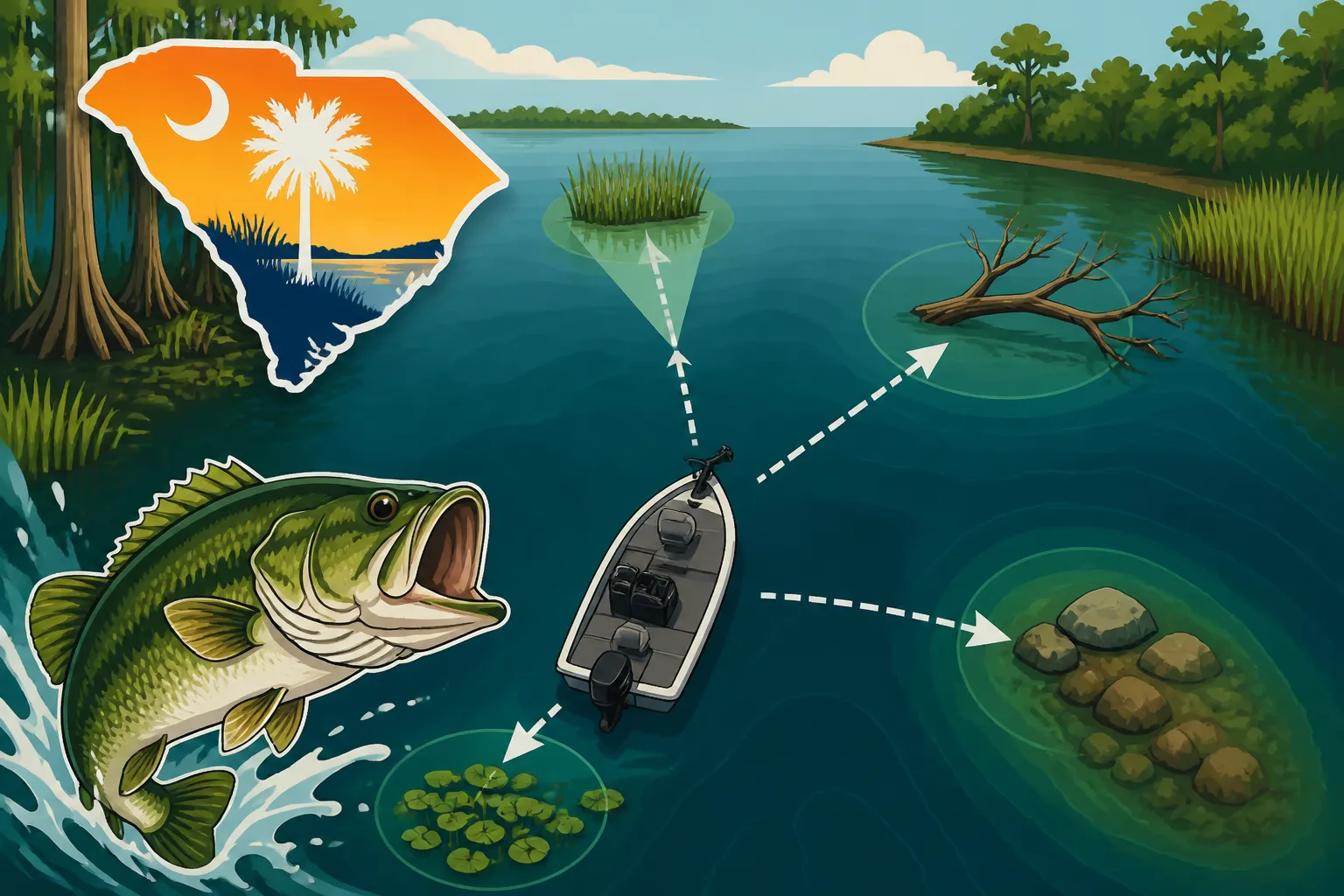
South Carolina's diverse waterways, from the vast reservoirs like Lake Murray and the Santee Cooper lakes to countless rivers and ponds, offer a variety of structures that bass call home. Each of these structures demands a slightly different boat positioning strategy to be fished effectively. Understanding these nuances will dramatically increase your success rate.
Docks and Piers: Precision and Patience
Docks and piers are bass magnets, offering shade, cover, and ambush points. However, they can be tricky to fish due to their intricate nature and the need for accurate casting. The key here is to position your boat to make precise casts under or alongside the dock, rather than just casting to the edge.
- Parallel Approach: Often, the most effective way to fish a dock is to run your boat parallel to it, keeping a casting distance away. This allows you to make repeated casts down the length of the dock, hitting multiple pilings, crossbeams, and associated cover with each pass. It also lets you control your retrieve more effectively, keeping your lure in the strike zone longer. You might start at one end and slowly work your way down the entire structure, then turn around and work it again from the opposite direction to present your lure from a different angle.
- Angle Shots: For docks with specific features like boat lifts, ladders, or brush piled around the corners, an angled approach can be beneficial. Position your boat to allow for a direct, skip-cast or pitch into these tight spots. Once you've hit that specific piece of cover, reposition slightly to hit the next one.
- Deep Docks: If the dock sits over deeper water, bass might be suspended beneath it. Here, your boat positioning might involve getting directly over the deeper sections and vertical jigging, or making longer casts that allow your bait to sink to the desired depth before reaching the cover. Remember, every dock is a little different, so pay attention to the details.
Brush Piles and Submerged Timber: The Silent Approach
Brush piles and submerged timber are absolute goldmines for bass, but they're also notorious for snagging lures. The right boat position is crucial to get your bait into the thick stuff without getting hung up immediately.
- Upwind/Upcurrent: Whenever possible, approach brush piles from upwind or upcurrent. This allows you to use the natural forces to gently drift your boat into casting range, or to slowly move past the cover with minimal trolling motor input. This stealthy approach is vital as bass in brush piles can be very spooky. As you drift, make casts ahead of your boat, allowing your lure to sink into the cover.
- Fan Casting: Once in position, fan cast around the entire brush pile. Don't just cast to the middle; bass will often hold on the edges or slightly off the main body of the cover. Your boat's position should allow you to hit all sides of the cover without casting over the shallowest parts first, which can cause hang-ups. For those tricky casts, a powerful, quiet trolling motor can be a game-changer, allowing you to hold steady even in a breeze while you carefully pick apart the cover. You can find some excellent models on Amazon that offer both power and whisper-quiet operation.
- Maintaining Distance: Keep a respectful distance. Too close, and you'll spook the fish or cause your lure to fall too vertically, reducing its appeal. Too far, and you lose accuracy and feel. It’s a delicate balance that comes with practice. How to Fish Deep Structure for Bass in Summer goes into more detail about how fish relate to these types of structures.
Ledges and Points: Mapping the Contours
Ledges and points are classic bass highways, especially in larger reservoirs like Lake Hartwell or the Santee Cooper lakes. Bass will move up and down these contours, making boat positioning essential for intercepting them.
- Contour Following: The most effective technique is often to "contour follow." This means positioning your boat either directly over the top of the ledge, or parallel to it, and slowly moving along its length. Your fish finder will be your best friend here, showing you the exact depth changes and any associated cover. This parallel approach allows for long, controlled casts that cover a wide range of depths along the break.
- Deep Water Side: When bass are holding deep, you might position your boat on the deep water side of the ledge, casting shallower and dragging your bait down the break. This can be incredibly effective with crankbaits or Carolina rigs.
- Shallow Water Side: Conversely, if bass are pushing bait up onto the shallower top of the ledge or point, you'd position your boat shallower, casting towards the deep water and retrieving your bait up the slope. The key is understanding where on the structure the bass are likely to be based on factors like time of day, water temperature, and bait presence. Lake Murray Fishing Guide for South Carolina Anglers discusses these types of structures in specific detail for that fishery.
Grass Lines and Hydrilla Beds: Edge Control
Grass lines, whether emergent or submerged hydrilla beds, provide excellent cover and foraging grounds for bass. Positioning your boat here is all about working the edges and pockets effectively.
- Outside Edge: Often, you'll want to position your boat on the outside edge of the grass, making casts into the grass line or parallel to it. This allows you to retrieve your lure along the seam where the grass meets open water, a prime ambush point for bass.
- Inside Edge/Pockets: If there are significant pockets or points within a large grass flat, you might move your boat into the flat itself, positioning to cast directly into those key openings. Here, a shallow water anchor system can be invaluable, letting you quietly hold your position without spooking fish in the often-shallow water. You can find robust options for these systems on platforms like Amazon.
- Wind and Current: Always consider the wind and current. Position your boat so you can cast into or across the wind without fighting it excessively on your retrieve. This gives you better feel and allows for more natural lure presentations, especially with topwater baits or soft plastics.
Tools and Techniques for Precision Positioning
Having the right gear and understanding how to use it can transform your boat positioning from a constant battle into a seamless operation.
The Power of the Trolling Motor
A good trolling motor is arguably the most important piece of equipment for precise boat positioning. It allows for quiet, controlled movement that is essential for stealthy approaches and holding your boat steady against wind and current.
- Spot-Lock/Anchor Mode: Modern GPS-enabled trolling motors often feature a "spot-lock" or "anchor" mode. This technology is an absolute game-changer. It uses GPS to hold your boat in a specific position, even in strong winds or current, allowing you to cast freely without worrying about drifting. This is particularly useful when you've found a productive brush pile or a specific spot on a ledge. It frees you up to focus on fishing, not boat control.
- Momentary vs. Constant: Learn to use both momentary and constant modes. Momentary allows for quick bursts of power to adjust your position slightly or creep forward. Constant mode is good for slowly following contours or drifting along a grass line. The key is smooth, minimal adjustments to avoid spooking fish.
- Thrust and Battery Life: Ensure your trolling motor has enough thrust for your boat size and the conditions you typically fish in. A little extra power is always better than not enough, especially on windy days on big lakes. And make sure you have enough battery life to power it all day! You wouldn't want to run out of juice when the bite is hot.
Shallow Water Anchors: Holding Your Ground
For those times when you're fishing in shallow water (typically less than 15 feet), a shallow water anchor system can be incredibly effective. These devices quickly deploy a spike into the bottom, pinning your boat in place silently and securely.
- Benefits: They are much faster and quieter than deploying a traditional anchor, making them perfect for quickly stopping on a productive spot in a marsh or a shallow flat. They are also fantastic for holding your boat in place while you work a specific piece of cover, like a laydown or a single cypress tree.
- Applications: Think about fishing grass flats for redfish (yes, bass anglers chase redfish too!) or working a shallow shoreline on a lake like Lake Moultrie. Being able to stop dead in your tracks without a splash or noisy chain can mean the difference between catching fish and watching them dart away. There are several reputable brands that make these systems, and researching their features on a site like Amazon can help you find the right fit for your boat and fishing style.
Traditional Anchors and Drift Socks: Old School Control
While modern technology has given us incredible tools, don't underestimate the utility of traditional anchors and drift socks.
- Anchors: A well-placed anchor can still be the best option for holding your boat steady in current, especially in rivers or when fishing a very precise deep spot where a trolling motor might struggle. Just remember to deploy it quietly and upstream or upcurrent from your target to avoid spooking fish as the anchor chain drags.
- Drift Socks: Drift socks are excellent for slowing down your drift in windy conditions or strong currents, allowing you to thoroughly dissect a larger area like a deep flat or an expansive point. By deploying a drift sock, you can maintain a slower, more controlled presentation, which is often key when bass are less aggressive. South Carolina River Fishing Spots in South Carolina often require these types of current-management tools.
Adapting Your Position to Changing Conditions
The beauty and challenge of fishing lie in its dynamic nature. Conditions are rarely static, and a skilled angler knows how to adapt their boat positioning to whatever Mother Nature throws their way.
Wind and Current: Your Constant Companions
Wind and current are your most frequent challenges when it comes to boat positioning. They can either be your enemy or, if you learn to use them, your ally.
- Using the Wind/Current to Your Advantage: Instead of fighting them, try to use them to create a natural drift. Position your boat so the wind or current pushes you along a productive bank, a channel swing, or over a flat. This provides a natural, quiet presentation. Your trolling motor then becomes a steering mechanism, making minor corrections to keep you on track.
- Controlling Your Drift: If the drift is too fast, deploy a drift sock. If it's too slow, use your trolling motor for intermittent bursts of speed. The goal is a controlled drift that allows your lure to be presented naturally without being rushed through the strike zone. This is particularly important when working subtle structure or fishing with finesse techniques. Fishing Techniques After a Cold Front emphasizes how fish behavior changes, often requiring slower presentations and thus more controlled boat positioning.
Sun, Shade, and Clarity: Visual Factors
The position of the sun, the resulting shadows, and water clarity all play a significant role in bass behavior and, consequently, your optimal boat position.
- Sun and Shadows: On bright, sunny days, bass will often seek shade. Position your boat so your casts land in these shaded areas – under docks, against submerged timber, or on the shady side of a bluff. Also, be mindful of your own boat's shadow. Try to keep it from falling over the area you're fishing, especially in shallow, clear water, as it can easily spook fish.
- Water Clarity: In clear water, bass are more visually oriented and also more easily spooked. This means you might need to keep your boat further away from your target, opting for longer casts. Conversely, in stained or muddy water, bass rely more on vibrations and scent, so you can often get closer to the structure, allowing for more precise pitching and flipping. Best Fishing Spots in South Carolina will often have areas with varying water clarity throughout the year.
Stealth vs. Aggression: Balancing Your Approach
Sometimes, stealth is absolutely paramount. Other times, a more aggressive, faster approach is warranted. Knowing when to apply each is crucial.
- Stealth Mode: When fishing pressured waters, shallow areas, or targeting finicky bass, maintain maximum stealth. This means quiet trolling motor use, avoiding sudden movements, and long, accurate casts. Take your time, work each spot thoroughly, and focus on precise boat control.
- Search Mode: When trying to locate active fish over a large area, or when bass are particularly aggressive, you might cover water more quickly. This still requires good boat positioning to efficiently hit key targets, but your movements might be a bit faster. For instance, quickly moving from one point to the next, making a few key casts, and then moving on. However, even in search mode, avoid slamming gear around or running your outboard full throttle right up to a promising spot. Always aim to transition smoothly from searching to precise presentation once you locate fish.
By consciously thinking about your boat's position, you're not just casting; you're setting the stage for a successful day on the water. It's a skill that takes practice, but one that will pay dividends in your bass fishing adventures across South Carolina.
| Boat Positioning Tool | Primary Use Case | Best Conditions | Advantages | Considerations |
|---|---|---|---|---|
| Trolling Motor | Stealthy movement, precise adjustments, holding spot | Most conditions, especially wind/current | Quiet, precise, GPS spot-lock features | Battery life, thrust power for boat size |
| Shallow Water Anchor | Holding boat in shallow water (<15 ft) | Calm to moderate winds, shallow flats | Instant, silent deployment, hands-free fishing | Limited to shallow depths, can be pricey |
| Traditional Anchor | Static holding in strong current/deep water | Rivers, deep channels, calm conditions | Very secure, cost-effective | Noisy deployment, requires retrieval, less mobile |
| Drift Sock | Slowing drift in wind or current | Windy conditions, strong currents | Controlled drift, covers large areas slowly | Not for precise spot holding, can snag |
Disclaimer
This article is for general informational purposes only and does not constitute professional advice. Laws, prices and regulations vary by location and change over time. Consult a qualified professional for guidance on your specific situation.